

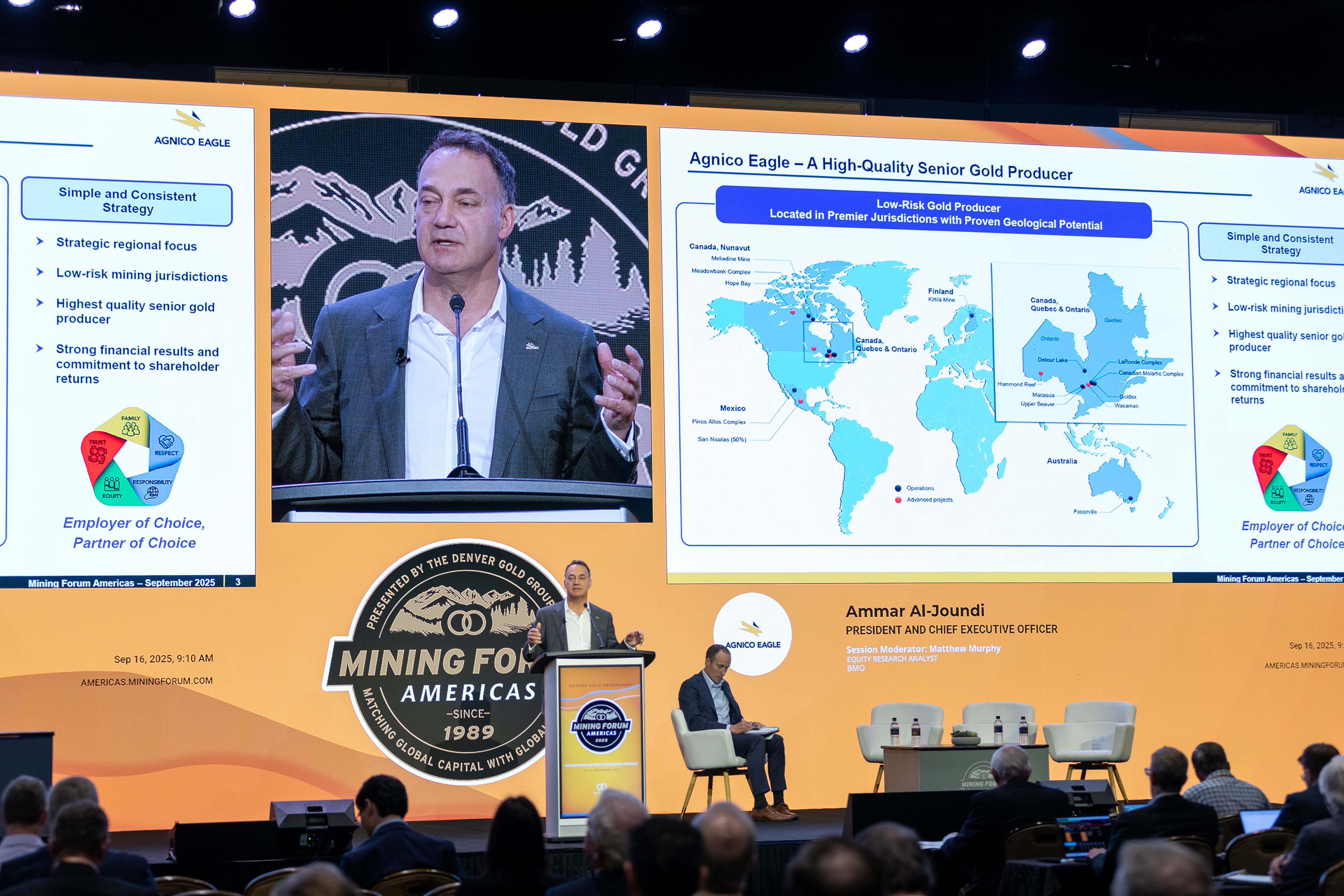
After a “remarkable” 2025, Agnico Eagle Mines (TSX/NYSE: AEM) is looking to the next decade of its growth.
While the company reported record financial results, the focus of its presentation was its organic growth options.
“The real excitement is not in looking back or even the next three years,” Agnico Eagle president and CEO Ammar Al-Joundi said during a conference call on Friday.
“The real excitement this morning is that Agnico Eagle is in the best position we’ve ever been in, and we’re already aggressively advancing our next phase of growth, and growth per share.”
The company outlined a plan to increase production by 20-30% over the next decade with a path to more than 4 million ounces of annual production by the early 2030s.
“This growth is from the highest quality projects in the best jurisdictions in the world,” Al-Joundi said.
“This growth is from projects we already own in jurisdictions we know well, with existing teams and in most cases, leveraging off existing infrastructure.
“This is important because our job isn’t simply to grow, but rather it’s to grow value for our owners on a per-share basis, and in our industry, growing in stable jurisdictions, leveraging existing infrastructure not only delivers to our owners the best return on capital, but also the best risk-adjusted return on capital.”
The company’s current expansion and growth projects are expected to add 1.3-1.5Moz of production, with initial step-up expected in 2030, which could result in a net addition of 700,000oz to 1Moz over the next decade.
The goal includes plans to reach 1Moz of annual production each from Detour Lake and Canadian Malartic, which are already Canada’s two largest gold mines.
Agnico Eagle is also advancing Upper Beaver, Hope Bay and potential base metal production from San Nicolás in Mexico.
Nearer term initiatives include increasing mining and processing rates at Macassa to 2150 tonnes per day and at Fosterville to 3300tpd in the next three years, as well as further extending Meadowbank’s mine life.
Given the high gold price, Agnico is re-evaluating the earlier stage Hammond Reef, Timmins East and Northern Territory assets, which could provide additional production growth.
‘Willing to move’
Like exploration or project investment, Al-Joundi said M&A had to create value for Agnico Eagle shareholders on a per-share basis.
“What does that mean for M&A? That means a couple of things. The first part is, are you positioned to be able to identify and assess good opportunities to invest your owners’ money, including in M&A? And I think we’re very well-positioned,” he said.
“It’s easy to buy stuff. It’s hard to buy stuff that makes money for your owners, so the first thing is, are you positioned to have a knowledge advantage? And I think we are well positioned there.
“But what I would say is we are willing to move, and we have moved when we see an opportunity on the M&A side that actually creates value per share. We’re not interested in just getting bigger.
“The hard part is actually creating value per share, and so that’s going to always be the driver, not only of M&A but all of our capital allocation decisions.”
Al-Joundi said any M&A would have to compete with the company’s internal projects.
“Like anything else, you want to pick the best investment for your owners,” he said.
“So, on the one hand, internal projects, you always have more knowledge. You just do. If I had something at the same return that’s internal versus external, your natural reaction would go to the one that you have more confidence in, which is always internal.
“That said, you know what would really interest us, and what has really driven us for external M&A has really been exploration upside.
“If you buy a high-quality asset, you end up paying what seems like a full price, but the real value is, do you have a very strong view on the exploration upside? And that’s, frankly, been the modus operandi of what we’ve done on the M&A side – the real return to our owners has been from expanding well beyond the initial view of what was there.”
Record results
Agnico Eagle reported record full-year cash provided by operating activities of US$6.81 billion, or US$13.58 per share, and free cashflow of a record US$4.39 billion, or US$8.76 per share.
Net income more than doubled to US$4.46 billion.
The result included quarterly net income of US$1.52 billion, record adjusted net income of US$1.35 billion, cash provided by operating activities of US$2.11 billion and record free cashflow of US$1.31 billion.
Agnico produced 3.44Moz of gold in 2025, above the mid-point of guidance, with Q4 production of 840,608oz.
Total cash costs of US$979 an ounce and all-in sustaining costs of US$1339/oz were slightly above the top end of guidance, primarily due to higher royalty costs of roughly US$42/oz.
“While the price of gold went up US$1700 year over year, our cash costs went up US$76 per ounce,” Al-Joundi said.
“This means we delivered over 95% of this gold price increase to the benefit of our shareholders, delivering on our core mandate of providing gold upside leverage to our owners in 2025.”
Agnico’s net cash position improved to US$2.67 billion with cash of US$2.86 billion, up US$511 million, and debt of US$196 million.
The company increased its quarterly dividend by 12.5% to US45c per share.
Agnico paid US$803 million in dividends in 2025 and repurchased US$600 million worth of shares.
The company plans to seek approval to renew its buyback in May for another year and increase the limit to US$2 billion.
Guidance reaffirmed
Agnico Eagle released updated three-year guidance with the previous forecast of 3.3-3.5Moz of gold production in 2026 and 2027 remaining in place.
Guidance for 2028 of 3.3-3.5Moz has improved due to the extension of production at Meadowbank, as well as contributions from East Gouldie at Canadian Malartic, Fosterville and Kittila, which are expected to offset a temporary lower gold grade sequence anticipated at Detour Lake.
For 2026, the company forecasts total cash costs of US$1020-1120/oz and AISC of US$1400-1500/oz, a roughly 12% increase with around 60% of the increase reflecting higher royalty costs and a strong Canadian dollar, and 40% of the increase reflecting cost inflation of approximately 4% and the mining sequence.
“Excluding those assumptions, our cost increase is about 4-5%,” Al-Joundi said.
“This would be at or slightly below the inflation we saw in the industry last year, so good cost control on the factors that we can influence.”
Capital expenditure will rise to US$2.2-2.4 billion from US$2.1 billion in 2025, reflecting investments at Detour Lake and Upper Beaver.
The amount also includes an initial US$102 million for Hope Bay, which could be supplemented by US$300-350 million for the reminder of the year if a potential construction announcement is made in the June quarter.
In 2026, the company’s total exploration expenditures and project expenses are expected to be US$565-635 million, including approximately US$384 million for capitalised and expensed exploration, and approximately US$216 million for advanced exploration project expenses, studies and other corporate development activities.
The company’s year-end gold reserves rose by 2.1% to a record 55.4Moz at 1.3 grams per tonne gold.
Measured and indicated resources were up 9.6% to 47.1Moz at 1.22g/t gold, while inferred resources were up 15.5% to 41.8Moz at 2.49g/t gold.