
Banks Agree on Higher Gold Prices in H2
Checking in on gold at the year’s halfway mark


June has seen the gold price dip to 2026 lows and the forecasts for the remainder of the year varies between banks, though all are in agreement that prices are moving higher from here.
Spot gold briefly dipped below US$4000 an ounce this week, a price not seen since early November 2025.
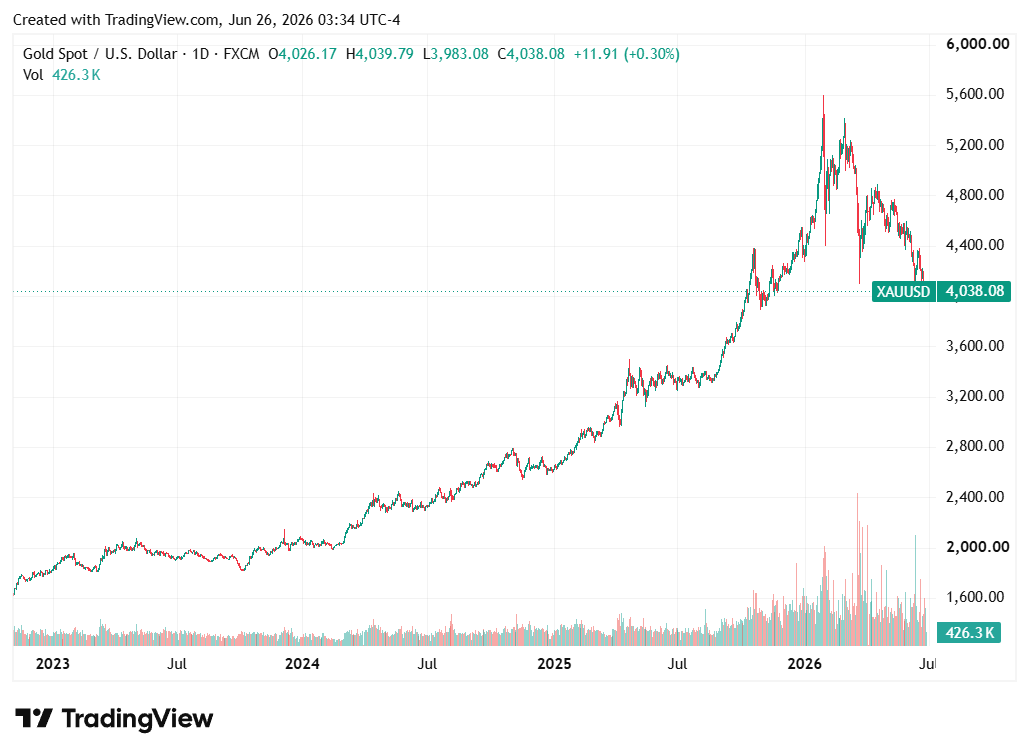
The weakness, attributed to a cooling of tensions in the Middle East, the rising chances of a US interest rate cut and a pivot of investor interest into the SpaceX float, has resulted in several downgrades to H2 2026 forecasts.
Earlier this month, Goldman Sachs lowered its year-end price forecast by US$500/oz to US$4900/oz, citing the likelihood of a Federal Reserve rate cut.
This week, Deutsche Bank reportedly cut its Q3 gold price forecast by 22% to US$4300/oz, though it sees gold rebounding to US$4800/oz in Q4.
More upside
While several other banks lowered forecasts for gold, their target prices are well above the current spot price.
RBC Capital Markets lowered its 2026 price forecast by 17% to US$4760/oz and its 2027 forecast by 19% to US$5250/oz.
“Our updated projections incorporate a pivot in our rate outlook to tightening monetary policy and rising yields over 2H26, a change versus our prior expectation of continued easing,” analyst Kaan Peker said.
“Near-term gold price gains are challenged by this potential further upside in yields, a function of Iran war uncertainties and rising inflation expectations.
“However, a resolution of these outstanding uncertainties is forecast to result in upside to prices, which we still forecast over 2027 versus current levels.”
RBC’s scenario analysis outlines 2026 year-end upside pricing of US$6200/oz and downside of US$4700/oz, while it maintained its long-term gold price forecast of US$4000/oz.
Meanwhile, J.P. Morgan Global Research still expects gold to average US$6000/oz by the end of 2026, rising to US$6300/oz next year, though those forecasts are 4-5% lower than its February 2026 outlook.
It cut its Q3 2026 forecast by 10% to US$5300/oz.
J.P. Morgan said one of the strongest drivers of the medium and long-term bull case for gold was central bank buying, though the strong pace set between 2021 and 2025 appeared to have cooled this year.
The World Gold Council’s annual Central Banks Gold Reserves Survey, released earlier this month, revealed that 89% of reserve managers expected global central bank gold holdings to continue increasing over the next 12 months.
J.P. Morgan head of base & precious metals Greg Shearer said China appeared to be making unreported purchases.
“Chinese net imports of gold have inflected higher, coming in at 317t in the first quarter of 2026, up by nearly three times compared to the previous quarter,” he said.
“Furthermore, the People’s Bank of China has ramped up its reported purchases, from around a 1t-per-month pace for the six months through February to 5t in March and 8t in April.”
The bank also noted that China’s top 10 insurance companies received regulatory approval last year to allocate up to 1% of their assets under management to physical gold, with speculation that could be lifted to 5%.
Shearer said Fed policy should shape gold’s trajectory.
“The most significant bearish risk to our view is a macro scenario where US growth and employment remain buoyant but inflation continues to accelerate, solidifying a Fed hiking cycle this year,” he said.
“A Fed that feels emboldened by stronger employment momentum and crystallises behind a need to fight higher for longer inflation could begin to crack investor demand.
“If it occurs, we would likely see a flip to more sustained Western ETF outflows, raising a persistent headwind for gold prices, particularly amid a dip in central bank buying intensity.”
BMO Capital Markets noted this week that after five consecutive weeks of outflows, gold ETF flows turned positive again last week, totalling US$1.33 billion, driven by Europe (US$890 million) and North America (US$378 million), following the prior week’s heavy outflows.
BMO sees scope for gold prices to recover, particularly if lower oil prices eased pressure on emerging market demand and provided room for a reduction in import duties in India.
“This would likely support a rebound in physical demand, while silver and PGMs are likely to continue to lag as industrial market balances loosen.”
It sees gold averaging around US$4625/oz in H2, down 5% from its previous forecast.