
Discovery Lays Out Multi-Generational Vision for Timmins
Growing company does deal with Glencore to expand gold production

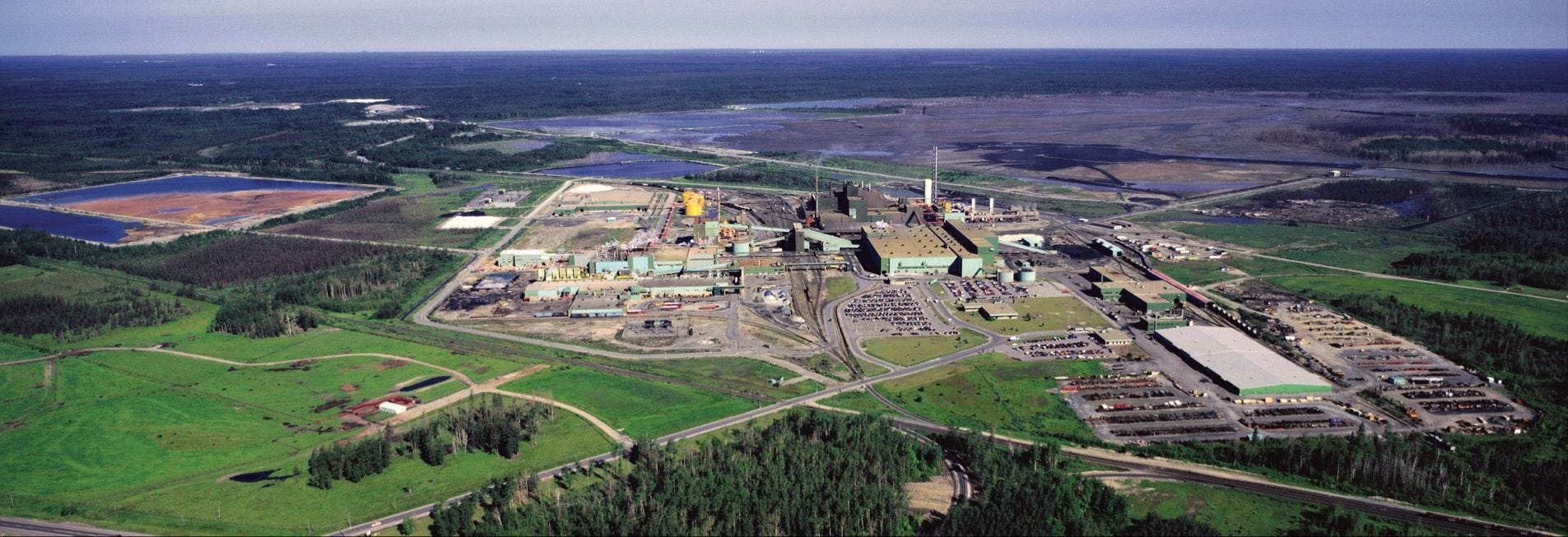
Discovery Silver Corp (TSX: DSV) has signed a deal with Glencore (LSE: GLEN) to acquire the Kidd operations in Timmins, Ontario.
Consideration comprises the issue of US$10 million worth of shares to Glencore, the signing of offtake arrangements related to concentrates produced from the Kidd operations, and a 1% net smelter return royalty on minerals produced from a large exploration land package outside of the existing Kidd Creek operations.
The agreement also includes a deferred payment of up to US$75 million, payable either in cash or Discovery shares at the company’s discretion, upon receipt of all approvals required to deposit gold tailings at the Kidd tailings management area.
While the Kidd Creek mine is the world’s deepest base metal mine, with mining operations currently at the 9800-foot level and the shaft extending to the 9889ft level, the key attraction of the acquisition for Discovery is additional milling capacity for its nearby Porcupine Complex.
The Kidd Met site has four independent processing circuits, two of which are currently idled, significant tailings capacity, 90 megawatts of available power, a large metallurgical laboratory, fresh water supply and rail access.
“We picked up really a world-class facility here,” Discovery CEO Tony Makuch told the company’s investor day, held during the PDAC Convention in Toronto on Monday.
“We’re going to have to convert it. We’re going to have to make some changes and invest in it and convert it to a gold circuit, but it unlocks a lot of value in Porcupine for us and really that’s the main driver of the acquisition.”
Makuch said the ability to process tonnage from Pamour, Borden, Hoyle Pond and TVZ through Kidd would reduce haulage costs and allow the company’s Dome mill to process mineralisation from the adjacent Dome mine following an anticipated resumption of mining operations.
The acquisition also includes surface rights, which will also allow for the optimal placement of potential new infrastructure for Hoyle Pond, including development related to the TVZ project, as well as improve options for waste rock deposition from the Pamour mine.
“Really the big thing is, we feel very strongly we can grow this to half a million to 750,000 ounces a year production,” Makuch said.
“It’s not because we don’t have the resources or the minerals at Timmins to do that – we didn’t have the milling capacity, so now there’s a path.”
Base metals exposure
Kidd opened in 1966 and over the last 60 years has produced over 772 million pounds of copper, 2.1 billion pounds of zinc and 400 million ounces of silver.
Glencore announced plans last year to close the operations by the end of 2026.
Makuch said Kidd was Glencore’s single most profitable mine in 2025.
“Depending on when we take it over and if we run their current plan, we can still bring in plus-US$50-100 million, depending on pricing,” he said.
Makuch said there were studies into extending Kidd to beyond 10,000ft depth but it depended on the economics, as well as safety.
“And by the way, when you talk about safety, if I were to show you the Kidd safety stats over the last five years, they’re second to nobody in the world,” he said.
“It’s safer to work at Kidd underground at 10,000ft than to work at Walmart in Dallas, Texas.”
Discovery will undertake near-mine exploration with a goal of identifying new resources that could support future operations at the mine.
“If we only find 20% of the Kidd deposit, we found a major new deposit,” Makuch said.
The acquisition also gives Discovery a large, skilled workforce.
“We’ve got to invest in people. We’ve got to invest, we’ve got to train and develop, and we’ve got to recruit people, and we got to bring on a new generation of people for this industry,” Makuch said.
“Because we’re building a mining centre in Porcupine that’s multi-generational – we’re setting up here a 20 to 40-year plan.”
Cordero closer
As well as goals to produce 500,000-750,000oz of gold per year, Discovery is also aiming to produce 14Moz of silver per year from its Cordero project in Chihuahua, Mexico.
Cordero is the world’s largest undeveloped silver deposit and the company believes it’s close to receiving a permit.
“Cordero has always had an element of politics around it, but we think that’s going to come to an end very quickly,” Discovery senior vice president, investor relations Mark Utting said.
“We’re absolutely committed to making Cordero a shining example of how you can responsibly build and operate a large-scale open pit for the benefit of the people of the world.”
The company released a feasibility study released in February 2024, which generated a net present value of US$1.2 billion, based on a US$22/oz silver price.
At US$75/oz silver, the NPV increases to US$5.9 billion and again to US$7.2 billion in year four.
An updated study is due later this year.
Transformational year
Makuch was named as Kitco’s CEO of the Year last week following Discovery’s transformational year.
Discovery shares rose by more than 900% in 2025 following the April 2025 acquisition of Porcupine from Newmont Corporation (NYSE: NEM) for US$425 million.
Porcupine produced 180,424oz of gold between mid-April and the end of December.
Last month, Discovery reported a 6% increase in December quarter production to 66,718oz at cash costs of US$1185 an ounce, down 12%, and all-in sustaining costs of US$2034/oz.
Net cash from operating activities for the quarter was US$163.2 million, with free cashflow of US$67.9 million.
Net earnings were US$65.3 million, or US8c per share, with adjusted net earnings of US$113.5M, or US14c per share, up 75%.
The company’s December 31 cash position grew by 20% to US$410.7 million, with US$250 million of liquidity from an undrawn revolving credit facility and a US$100 million accordion feature.
Guidance for 2026 has been set at 260,000-300,000oz at operating cash costs of US$1250-1400/oz and AISC of US$1950-2250.
The company also announced front half-weighted sustaining capital expenditure of US$120-165 million and growth capital expenditure of US$195-235 million for Porcupine and US$90-100 million for Cordero.
Discovery, which will present at the 2026 Mining Forum Europe in Zürich next month, will also invest US$55-75 million in exploration.
“Our goal here is to invest and build,” Makuch said.
“This is not a dividend story. This is not a share buy-back story.
“If our return to shareholders is us creating, improving the value of the company, that’s the return we’re looking to build.”