
From Blueprint to Bullion: The Next Wave of Large-Scale Mine Builds
Government-backed financing, critical mineral designations, and gold above $3,000 are unlocking a pipeline of major projects that were stranded for years.

Perpetua Resources | Vista Gold Corp. | NorthIsle Copper and Gold |
Orvana | Andean Precious Metals
MINING FORUM EUROPE 2026, ZÜRICH -For years, the mining industry’s development pipeline was stuck. Capital costs escalated, permitting timelines stretched, and investors demanded immediate cash returns over multi-year construction risk. Projects with world-class resources languished because the economics did not clear the hurdle at $1,800/oz gold. At Mining Forum Europe 2026, that narrative flipped. With gold sustained above $3,000/oz, government financing program for critical minerals expanding rapidly, and a generational shortage of new mine supply becoming impossible to ignore, a cohort of development-stage companies presented projects that are now not only viable — they are among the most attractive risk-adjusted investments in the sector.
Perpetua Resources: Gold, Antimony, and the US Government
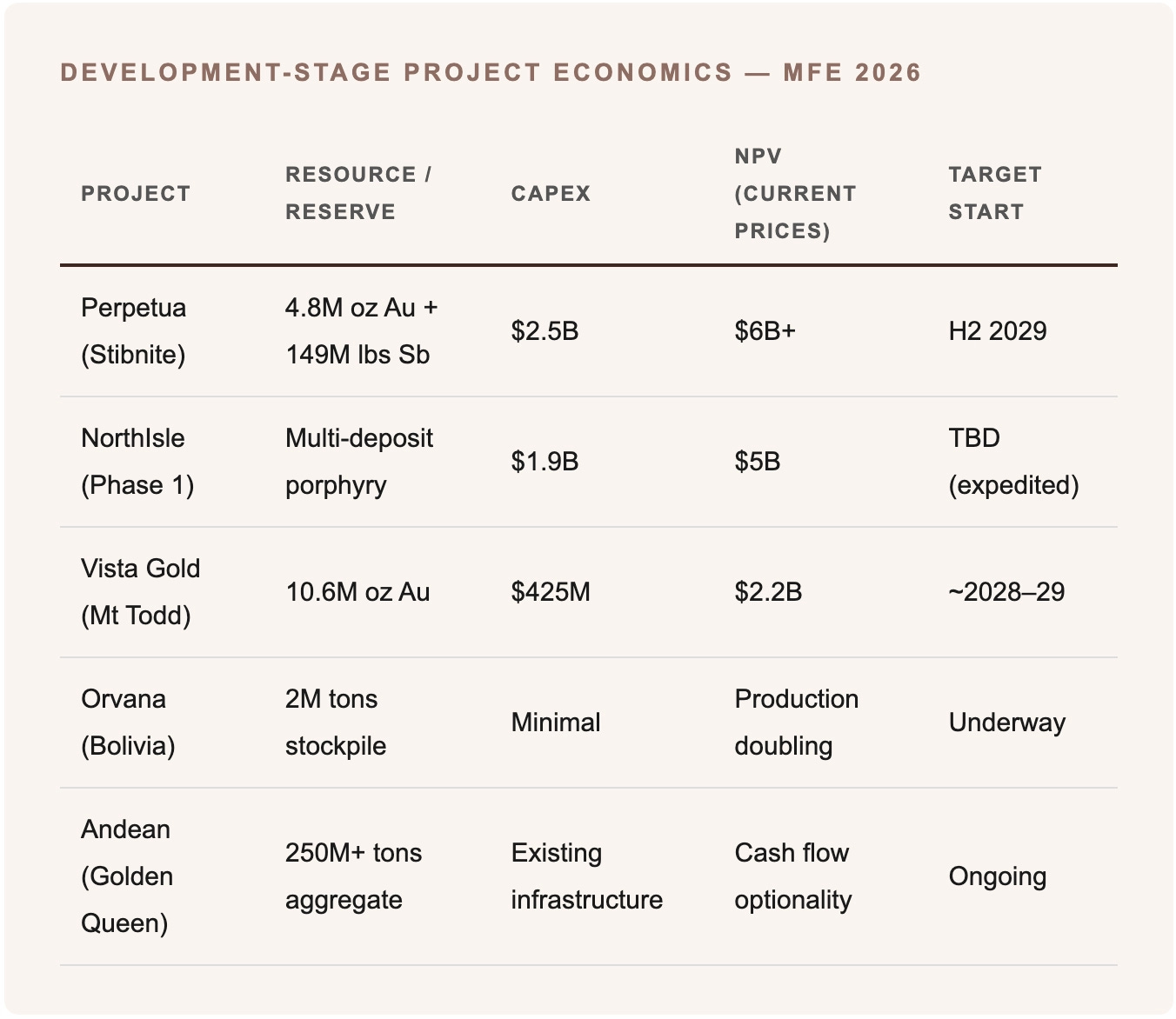
Perpetua Resources holds what may be the single most strategically important mine development project in the United States. The Stibnite Gold Project in central Idaho hosts 4.8 million ounces of gold reserves — the largest high-grade independent gold project in the US outside of Nevada joint ventures — plus 149 million pounds of antimony, one of the world’s largest reserves of a mineral now classified as critical to national defense.
The economics are compelling: at $3,250 per ounce gold, the project returns an NPV of $3.5 billion and generates 463,000 ounces per year in the first four years at all-in sustaining costs of roughly $220 per ounce (after antimony credits). At spot prices, the NPV exceeds $6 billion. But what truly distinguishes Perpetua is the government support. The Department of Defense has committed over $80 million for antimony processing through a pilot plant at Idaho National Labs. The US Export-Import Bank has approved a $2.7 billion loan, one of the largest ever for a domestic mining project, pending Congressional notification.

With $714 million in cash (following an $850 million equity raise), construction underway since fall 2025, and Hatch hired as EPCM contractor, Perpetua is targeting first production in the second half of 2029. Major shareholders include Paulson & Co., Agnico Eagle ($180 million), and JPMorgan. Notably, the project also has a meaningful tungsten component that management flagged as an emerging priority as tungsten supply chains face their own geopolitical pressures.
“Grade pays, tons cost. This is a high-grade gold project with critical mineral credits — and the US government is backing it.” — Perpetua Resources
NorthIsle Copper & Gold: Vancouver Island’s Critical Metals Play
NorthIsle Copper & Gold presented a project that reads like it was designed to check every box on a government critical minerals wish list. Located on Vancouver Island in British Columbia, the company’s copper-gold porphyry project returned a PEA in February 2025 showing an after-tax NPV of $2 billion and a 29% IRR at $4.20 per pound copper and $2,150 per ounce gold. At current prices — roughly $2,900 gold — the NPV jumps to $5 billion with a 45% IRR.
The phased mine plan is clever. Phase 1 begins with a 15,000-tonne-per-day underground operation targeting 200,000 ounces of gold per year for the first six-plus years, avoiding the massive upfront capital required for a large open pit. Total capex has been reduced from roughly $3 billion to $1.9 billion, and critically, the bulk of that can be funded from operating cash flow. The company raised $155 million in equity in the six months following the PEA and now holds $140 million in cash with no debt and no warrants.

The geological potential is district-scale: 100% ownership across 40 kilometres of a 50-kilometre porphyry belt, with a new discovery at West Goodspeed (1.2 km strike, not yet in resources) to be incorporated into an updated resource estimate in Q2 2026. British Columbia’s Critical Minerals Office has flagged NorthIsle as a top-priority project, and the company is working with Stanford’s MineralX programme to synthesise 70 years of inherited district data.
Vista Gold: Right-Sizing Mount Todd
Vista Gold’s Mount Todd project in Australia’s Northern Territory has long been one of the industry’s great “what ifs” — a 10.6-million-ounce resource (9.1 million measured and indicated) that never quite found the right economics. Previous developers designed it as a 50,000-tonne-per-day mega-operation requiring over $1 billion in capital. Vista has taken the opposite approach: right-size it to 15,000 tonnes per day, raise the cutoff grade from 0.35 to 0.5 g/t (improving the reserve grade to 1.04 g/t), and build a mine that produces 150,000 ounces per year for 20 years at an initial capex of just $425 million.
At $2,500 gold, the project shows an after-tax NPV of $1.1 billion and a 28% IRR. At $3,300 gold, those figures jump to $2.2 billion and 45%. The company has $55.5 million in cash with no debt, and is building out an Australian development team in Perth. Permitting modifications for the smaller operation are advancing, with environmental mining licence conversion expected late 2025 or early 2026 and federal authorisation targeted for mid-2026.

Management addressed Mount Todd’s historical reputation for ore hardness head-on, arguing that the problem was not the ore body itself but the equipment chosen by previous developers. Metallurgical and geotechnical optimization work is ongoing, with potential to flatten pit slopes and further reduce stripping costs.
Orvana and Andean: Multi-Jurisdiction Diversification
Two smaller companies — Orvana Minerals and Andean Precious Metals — illustrated a different model of development: leveraging existing infrastructure and processing capabilities to grow production without greenfield construction risk.
Orvana is restarting its Bolivia oxide stockpile project, which will add 100,000 ounces of gold and 57 million pounds of copper over three years using material already mined and stockpiled. This effectively doubles the company’s production from its Spanish El Valle operation alone, using a simple processing route on oxide material grading 1.85 g/t gold and 1.89% copper. Meanwhile, deep drilling at the company’s Taguas project in Argentina’s San Juan Province — situated in the same district as Barrick’s Veladero and Lundin’s multi-million-ounce projects — is testing porphyry potential that management described as potentially “game-changing.”

Andean Precious Metals, which operates its San Bartolomé processing facility in Bolivia and the Golden Queen mine in California, is pursuing a different kind of optionality. The San Bartolomé operation uses a unique “cash flow spread” model — buying ore from cooperatives, processing it, and selling the metal — that has generated positive cash flow every year since the company’s founding in 2017. The more interesting long-term story, however, may be the aggregate business at Golden Queen, where a permit valid until 2061 covers a potential 250+ million tonnes of waste rock for processing. With $177 million in liquidity and a 48% insider ownership stake, Andean is positioned to pursue growth without external capital.

The Enabling Environment
What connects these projects is that they are all benefiting from an environment that has become dramatically more supportive of new mine construction than at any point in the past decade. Gold above $3,000 has improved the economics of every gold project on the planet. Government critical minerals programs in the United States, Canada, and Australia are providing financing, expedited permitting, and political cover that did not exist three years ago. And after years of supply stagnation, the industry is recognizing that without new mines, the gap between demand and production will only widen.
For investors, the development stage represents the highest-risk and highest-reward segment of the mining value chain. But the projects on display at MFE 2026 have de-risked considerably: they have cash on their balance sheets, government support in their back pockets, and gold prices that provide enormous margin for error. The next three years will determine which of these blueprints become producing mines — and the companies that execute successfully will be rewarded with the kind of valuation re-ratings that define mining cycles.