
In Gold We Trust: The Remonetisation of Gold is Accelerating
The ‘Golden Decade’ is increasingly being confirmed

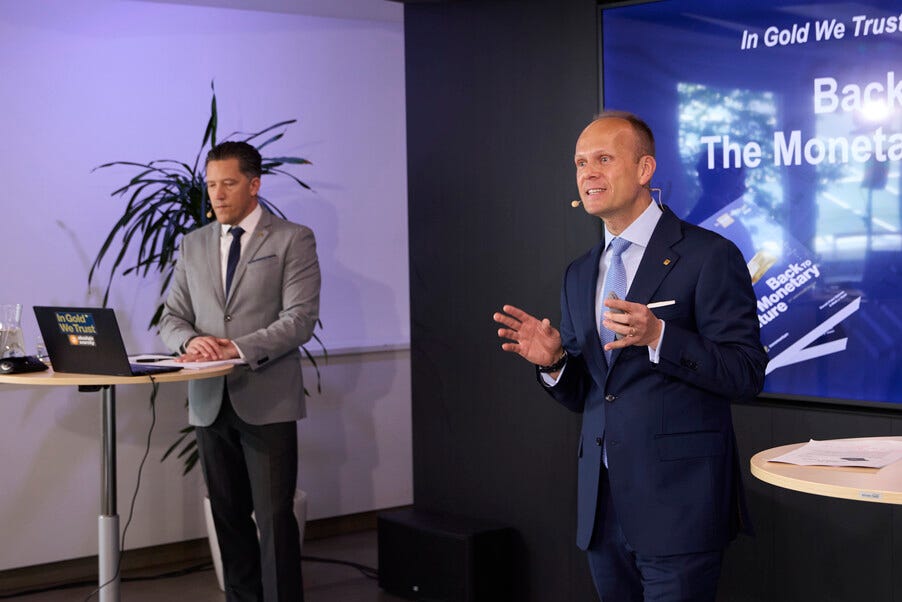
The 20th edition of the In Gold We Trust report was released on Wednesday by its authors, Incrementum AG fund managers Ronald-Peter Stöferle and Mark J Valek.
Following on from ‘The Big Long’ last year, this year’s 460-page report is entitled ‘Back to the Monetary Future’.
“We announced the so-called ‘Golden Decade’ in 2020 and it’s clearly playing out in real time – monetarily, fiscally, but also macroeconomically,” Stöferle said during a press conference on Wednesday.
“The leitmotif ‘Back to the Monetary Future’ means that we’re seeing a world in upheaval in which gold regains monetary relevance, so from our point of view, it’s not just a normal gold cycle, it is really a monetary cycle that we’re in.”
Valek stressed that they did not believe there would be a return to a classic gold standard.
“This is not what we have in mind, but what we are witnessing already, and we are actually of the opinion that these developments will keep increasing, is basically gold regaining monetary relevance,” he said.
The report identified six key vectors of gold remonetisation: reserve function and sovereignty; private and institutional demand; accounting and recapitalisation; gold-backed bonds as an anchor of credibility digitalisation and tokenisation; accumulation by Western central banks; and digitalisation.
On the last point, Valek noted that tokenisation had not yet become widespread.
“Tether Gold by now is holding 16 tonnes of gold, which is tokenised in gold tokens, but more importantly, in terms of value, is 125 tonnes, which they are holding as backing for their USDT stable coin,” he said.
“So, Tether is the market leader when it comes to US dollar stable coins, with a market capitalisation of almost US$200 billion and interestingly enough, roughly four percentage points of these assets are backed by gold.
“125 tonnes alone would bring Tether into the realm of one of the biggest holders of gold when it comes to countries, so it would be on rank 34-35 between Sweden and South Africa, so a very respectable and relevant player in the gold market.”
The 2024 IGWT report introduced an alternative to the traditional 60:40 portfolio, comprising 45% stocks, 15% bonds, 15% safe haven or physical gold, 10% performance gold (gold and silver equities), 10% commodities and 5% bitcoin.
“Interestingly, we’re not alone anymore with this kind of idea,” Valek said.
“Last year, Morgan Stanley came out with a 60:20:20 portfolio, which is, I think, for an US investment bank, which typically is quite sceptical towards gold, quite an important step.
“This just goes to show that I think this development is only the beginning, and it’s also very, very important to note that obviously bonds are the biggest asset class of all of them, so if this kind of rotation really gets some traction, this obviously is a big part of the case for gold.”
Gold bull market to continue
Stöferle reflected on the first IGWT report, released in 2007.
Back then, the gold price was sitting at around US$670 an ounce. January 2026’s record highs of around US$5595/oz represent a more than eightfold increase.
Stöferle said the authors’ main thesis was that gold was not a contrarian asset.
“Gold is in a secular bull market, but we’re not in a bubble yet,” he said.
“I would say in football terms, we’re somewhere like in the second half of this game – perhaps we can go to overtime, perhaps we can go to penalty shooting.
“Based on a number of factors and historical comparisons, I think it’s pretty obvious that this bull market could still have legs now.”
Stöferle pointed to current gold allocations by private investors of just 2.7% last year, compared to the all-time high of 8.3% in 1980.
“If we compare the allocation of central banks, which is now 26% compared to 1980 – back then we were at 62%, just based on those two numbers, I think it’s pretty obvious, yes, we’re in an uptrend, we’re in a bull market, but we’re definitely far away from those extreme levels like we saw at the beginning of 1980.”
In 2020, the report forecast a gold price of US$4800/oz by the end of this decade, and US$8900/oz in inflationary conditions.
“We were kind of ridiculed – nobody really believed what we said, but actually we already overachieved the base case scenario, and we’re right on track for the long-term target in the inflationary scenario,” Stöferle said.
“US$8900 still sounds somewhat outlandish to many people these days, but that’s a CAGR of only 14% from now until the end of 2030 which is, from our point, quite realistic now.”
Gold is currently trading at a more than 30-day low of just over US$4500/oz.
“Gold is not a one-way street,” Stöferle said.
“I think it’s quite normal that we’re now taking a breather, and based on the sentiment, you can see that there’s quite a lot of bullishness that actually left the gold sector over the last couple of weeks, so, from our point of view, it is normal and it’s a healthy consolidation that we’re seeing.”
Equities healthy
Stöferle has been analysing mining stocks for 20 years and said the gold sector had never been in a better position.
“The EBITDA margin, for example, 56%, the net margin almost 30%, free cashflow margin at 25%,” he said.
Earnings per share was US$1.05 in the first quarter of 2023 and had risen to US$4.63 in the March 2026 quarter.
“Which means we’ve seen a decent performance in the mining space, but actually fundamental results massively outperformed the share price performance, so actually, the price earnings ratio came down over all those years,” Stöferle said.
The report sees mining equities as being undervalued.
“We’ve seen that the balance sheets of the mining industry got significantly more healthy – they’re debt-free, they’re purchasing their own stock, they’re increasing their dividends,” Stöferle said.
There has already been an uptick in gold sector consolidation.
“But I think this M&A wave will definitely pick up momentum,” Stöferle said.
“We’ve recently saw Equinox with the merger with Orla, we saw SilverCrest being taken out by Coeur, we saw Agnico Eagle consolidated their properties in Finland, taking over Rupert and also Aurion.
“But from our point of view, this is only the beginning.
“We haven’t seen this crazy M&A mania that we usually see at the end of a big bull market, and again, those mining companies are producing a tremendous amount of free cashflow at the moment.”