

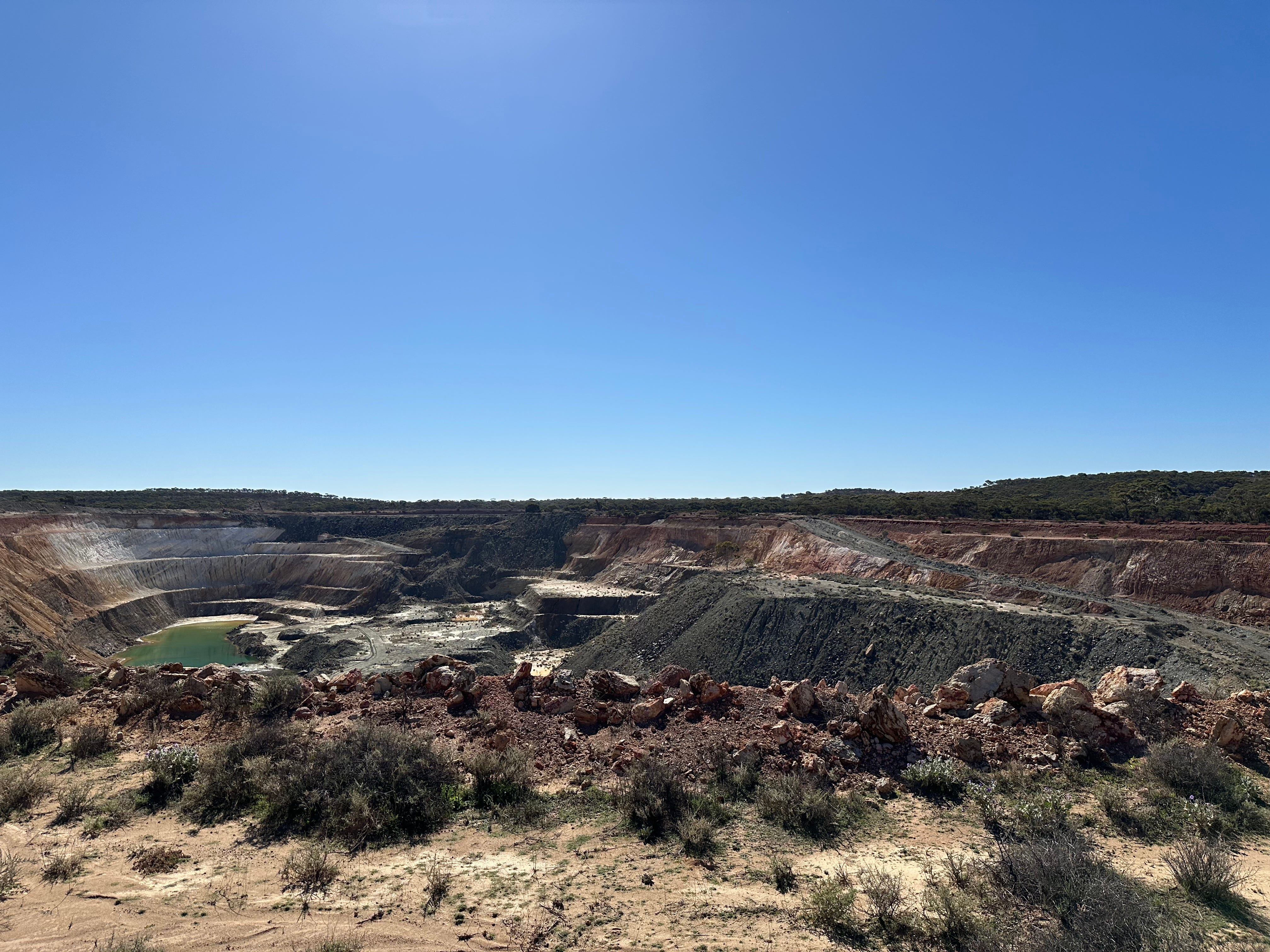
This time last year, Minerals 260 (ASX: MI6) was a little-known grassroots explorer. It now holds one of Australia’s largest undeveloped gold projects.
Minerals 260 opened 2025 with the acquisition of the 2.3 million ounce Bullabulling project in Western Australia’s Goldfields from Chinese major Zijin Mining (SH: 601899) for A$166.5 million in cash and shares.
It was a huge deal for the company, given its modest market capitalisation of around A$30 million at the time.
To pull it off, Minerals 260 had to raise A$220 million at A12c per share, which was largely achieved due to the pull of its founder and chairman Tim Goyder.
Goyder, a well-known Perth-based mining entrepreneur, is best known as the founder of lithium producer Liontown (ASX: LTR) and palladium developer Chalice Mining (ASX: CHN).
The cash raised allowed Minerals 260 to complete the acquisition and embark on a major drilling campaign at Bullabulling.
“Twelve months ago, we were a A$30 million company. Six months ago, A$200 million. Last month, A$600 million and today A$750 million, so to say it’s been a transformational year is an understatement,” Minerals 260 managing director Luke McFadyen told the Resources Rising Stars Summer Series in Sydney on Tuesday.
Aggressive drilling
Since completing the transaction in April, Minerals 260 has drilled 90,000m at Bullabulling, more than the 80,000m it originally planned.
On Monday, Minerals 260 reported a 2.2Moz jump in the Bullabulling resource to 130 million tonnes at 1 gram per tonne gold for 4.5Moz.
Despite only trading for around a minute on Monday due to an ASX glitch, the stock jumped 22% to an all-time high of A42c, briefly pushing its market capitalisation over A$900 million.
Two thirds of the resource sits in the indicated category, which will underpin mining studies.
“Three million ounces in indicated is larger than many mines already in production today,” McFadyen said.
“When we include the Gibraltar deposit, the total strike length is 14km long. It takes you over an hour to drive from Dixons to Gibraltar. That’s how big this resource is.
“The drilling this year culminated in the resource upgrade, so it’s been nothing but successful, but within the details, we’ve got some of the highest intercepts that this project has ever delivered, which is not an easy thing to do when it’s 40 years old, and had 12,000 holes drilled into it before we acquired it.”
Drilling will continue to target mineralisation at depth and along strike with a further resource update planned for next year.
While 530,000m had been drilled prior to Minerals 260’s ownership, very little drilling has been completed at depth and the resource remains open down-dip.
Brownfields development
Bullabulling was originally developed by Resolute Mining (LSE/ASX: RSG), but it was put on care and maintenance in 1998 when the gold price was around US$500 an ounce, after producing 179,000oz of gold.
Several gold juniors attempted to redevelop the project before Norton Gold Fields, a subsidiary of Zijin, acquired it in 2014.
While Zijin had carried out some work, the project had largely sat dormant for over a decade.
“When we first saw the data and information through due diligence, we started building a list of features that we liked, and that list has continued to grow all year,” McFadyen said.
“There are several highly valuable features of Bullabulling, for example, the Native Title agreement that allows us to mine tomorrow, if we really wanted to, the simple metallurgy and the location [45 minutes from Kalgoorlie], but most importantly, it’s the commodity and the sheer scale of 4.5 million ounces today in a gold bull market.”
A prefeasibility study is already underway, targeted for completion next year ahead of a final investment decision in 2027.
“We continue to target the second half of 2028 for first production, and we continue to look at the ways to do this sooner,” McFadyen said.
“We can achieve this with the way we think about developing projects, but also with the significant amount of historical work that we acquired through the acquisition.”
McFadyen said people sometimes asked why the company would develop a standalone project instead of toll treating given the number of mills in the region.
“While it’s all about value, and value for our shareholders, today, we’re valued at about A$200 an ounce in the ground,” he said.
“If we develop this and build our own plant, we should be valued at somewhere between A$1000 and A$1500 an ounce, so there’s a between a five and seven times uplift in our value if we get our execution right.
“We believe we offer the best developer exposure to the Australian gold price on the ASX via 4.5 million ounces, which is the largest resource not owned by a producer, the second largest open pit resource, and the third largest project not built in Australia yet.”