
New Highs for Gold Ahead, says Jefferies’ Chris Wood
Markets remain reasonably calm, despite Iran war but US economy looking increasingly shaky

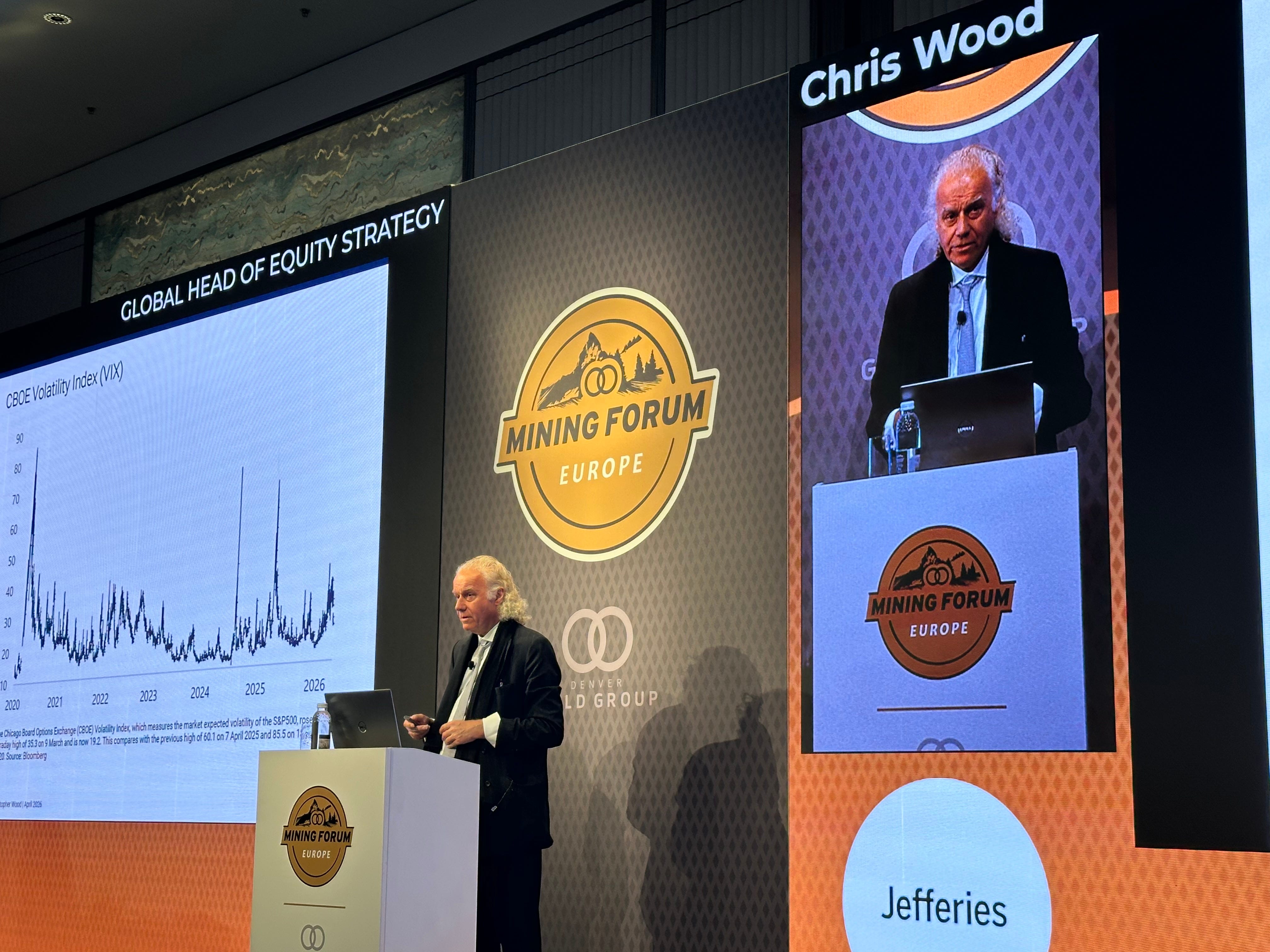
Jefferies global head of equity strategy Chris Wood told the first day of the 2026 Mining Forum Europe in Zürich that he would be surprised if the gold price didn’t reach at least US$10,000 an ounce.
Wood said he wasn’t surprised that the gold price had fallen since the start of the Iran war as investors sold for liquidity reasons.
“Actually, that’s why you have gold, so you can sell it in this environment,” he said.
“But to me, this is a healthy consolidation, and my base case for the low of gold in this consolidation will be the US$3800-4000 level.
“That’s a level that if you want to own gold and gold stocks, you should be buying more.”
Wood’s conservative gold price target is based on comparing gold as a percentage of US disposable income per capital.
When the gold price peaked at US$850/oz in 1980, it was equivalent to 9.9% of US disposable income per capita.
At US$4750/oz, it is just 6.9% of US disposable income per capita.
Therefore, for gold to reach 9.9% of US disposable income per capita, the price would need to be US$6798/oz.
“But the more aggressive way of valuing gold, which is entirely, totally logical, is to compare the gold price as a percentage of US M2,” he said.
“Because comparing it as a percentage of US M2 is more reflective of what’s happened in the last 10-15 years, which is the expansion of unconventional monetary policy in the G7 world and the expansion of central bank balance sheets.”
Gold’s 1980 peak represented 57% of US M2 but only represents 21% at current levels.
“So, to reach 57% of current US M2 in US billion dollar terms, gold would rise to US$12,995 an ounce,” Wood said.
“It would be a surprise in the current direction of travel, in my view, if gold didn’t reach US$10,000 at a minimum, and the more we get fiscal deterioration in the US, the more likely we’re likely to get, at some point, formal financial repression.
“By formal financial repression, I mean the Treasury and Fed actually fixing the price of longer-dated bond yields, like they did in Japan in recent years.”
Gold trades on real rates but that correlation was broken in 2022.
“The reason we broke it was when the world froze Russian foreign exchange reserves,” Wood said.
“Central banks outside the G7 were genuinely shocked, and that drew this big pickup in non-G7 central banks buying gold. Ever since then, the central banks have been net buyers of gold.”
Wood pointed out that central banks now owned more gold than the current market price of US Treasury bonds.
“That means we’re moving to what I’m calling a de facto gold standard,” he said.
“Nobody’s announced it’s a gold standard, but that’s what’s happening, and it’s happening not in the G7 world. It’s happening by non-G7 central banks adding to their gold holdings.
“The other thing that’s happened is that gold is now higher than the euro as a share of world official reserves, and the share of the US is declining.
“I’m not saying the US dollar standard is over. I’m just saying we’re in a transition to what I’m calling a de facto gold standard, and that’s global gold holdings by ETFs.”
Despite the recent pullback in the gold price, Wood said the charts didn’t indicate the end of a bull market.
“Much more likely it’s a period of consolidation and new highs ahead.”
Is AI a bubble?
According to Wood, the US market reached an all-time high as a percentage of global stock market capitalisation on Christmas Eve 2024 when it reached 67%.
“That doesn’t mean to say the US stock market has to collapse,” Wood said.
The large share reflects the strength of the tech stocks.
“The key issue for me, for the US stock market, is not the Iran war, it’s whether these tech companies in the US will be able to monetise their AI capex,” Wood said.
“Because the reality is, the US stock market has been dominated, since the beginning of ’23, by this AI capex story, as indeed has the US economy, so the four major US hyperscalers, plus Nvidia, account for 43% of the gains in the S&P 500 since the beginning of 2023.”
Wood believes AI capex will peak this year.
“The market is starting to question whether these hyperscalers are going to get a return from the enormous amounts of money they’re spending, and if you start to get a de-rating of the AI story, then it seems to me hard for the rest of the market to look through it.”
AI capex is forecast to reach US$620 billion this year.
“What’s been driving the US economy of late is AI capex – it accounted for about 50% of the growth in the US economy last year – but so far, there’s a lack of evidence of capex picking up in America outside of AI,” Wood said.
“In the absence of the AI capex, the US economy looks more and more vulnerable.”
Wood said many people viewed AI as the biggest bubble in this cycle.
“To me, it’s starting to be a bubble because they’re starting to borrow money to fund the AI investment,” he said.
“But the real bubble in this cycle, which I’ve identified the last three, four years, in my view, is quite clearly private credit and private equity.”
Wood said lending to non-bank financial institutions had surged.
“These dodgy loans are not in the junk bond market, they’re not in the high-yield market, they’re in the private credit market, which means when you get a deterioration in credit, you’re not going to get a warning,” he said.
“You’re going to get a loan going from being 100c to zero and obviously, we’re not even in a downturn yet.”
Wood said private equity firms had been doing leveraged buyouts in the software and AI sectors.
“You don’t have to be Einstein to understand that doing a leveraged buyout of a software company is intrinsically risky, and if the disruption on revenue retention is as big as what they’re saying, then that’s a disaster,” he said.
“Because in the US, some of these big endowments, pension funds, etc, have over 50% allocation to privates, which is quite incredible.
“It does raise the risk that they have to force sell their listed stocks because they can’t access the cash from their private investments.”
For now, calm
Wood has been amazed at how little the CBOE Volatility Index (VIX) has risen since the start of the Iran war.
It currently sits at just over 19.
“We reached the peak of 35 when Donald Trump announced his tariff agenda in April last year,” Wood said.
“What’s quite extraordinary is the lack of a more dramatic reaction, because if you were writing a financial thriller – the Strait of Hormuz being closed – you expect far more dramatic market action.
“I think that the best explanation is the financial markets are continuing to trade on what people refer to as TACO.”
TACO stands for ‘Trump always chickens out’ and Wood believes as a result of the TACO trade, the market wasn’t taking the conflict seriously.
“I think the psychology in the markets is that ‘is this going to last long?’ Because the markets are aware that, just from a purely domestic agenda of the US president, that this is a complete negative, so the market is just assuming he’s going to get out of it,” Wood said.
Wood said he didn’t believe the US would attack Iran because Trump campaigned on a no-war agenda.
“Because Venezuela was a coup for Donald Trump, the other thing to do was to do something in Cuba,” he said.
“If Donald Trump managed to change the Cuban regime, I reckon he would have won the midterms, but it’s now hard for him to do that.”
It had become increasingly clear that the Iranian regime would not capitulate.
“So, the market’s just assuming [Trump’s] going to try to get out of it,” Wood said.
“That’s the only way you can explain the market reaction.”