

Shares in Northern Star Resources (ASX: NST) partially recovered on Monday after slumping on Friday due to a guidance downgrade.
The A$35 billion gold miner opened 2026 with the news of a “number of isolated negative events” late in the December 2025 quarter, resulting in quarterly gold sales of just 348,000 ounces.
The company previously said the September 2025 quarter, in which it sold 381,000oz at all-in sustaining costs of A$2522 an ounce, would be the weakest of the 2026 financial year.
Northern Star has revised its FY26 production guidance to 1.6-1.7 million ounces of gold from 1.7-1.85Moz.
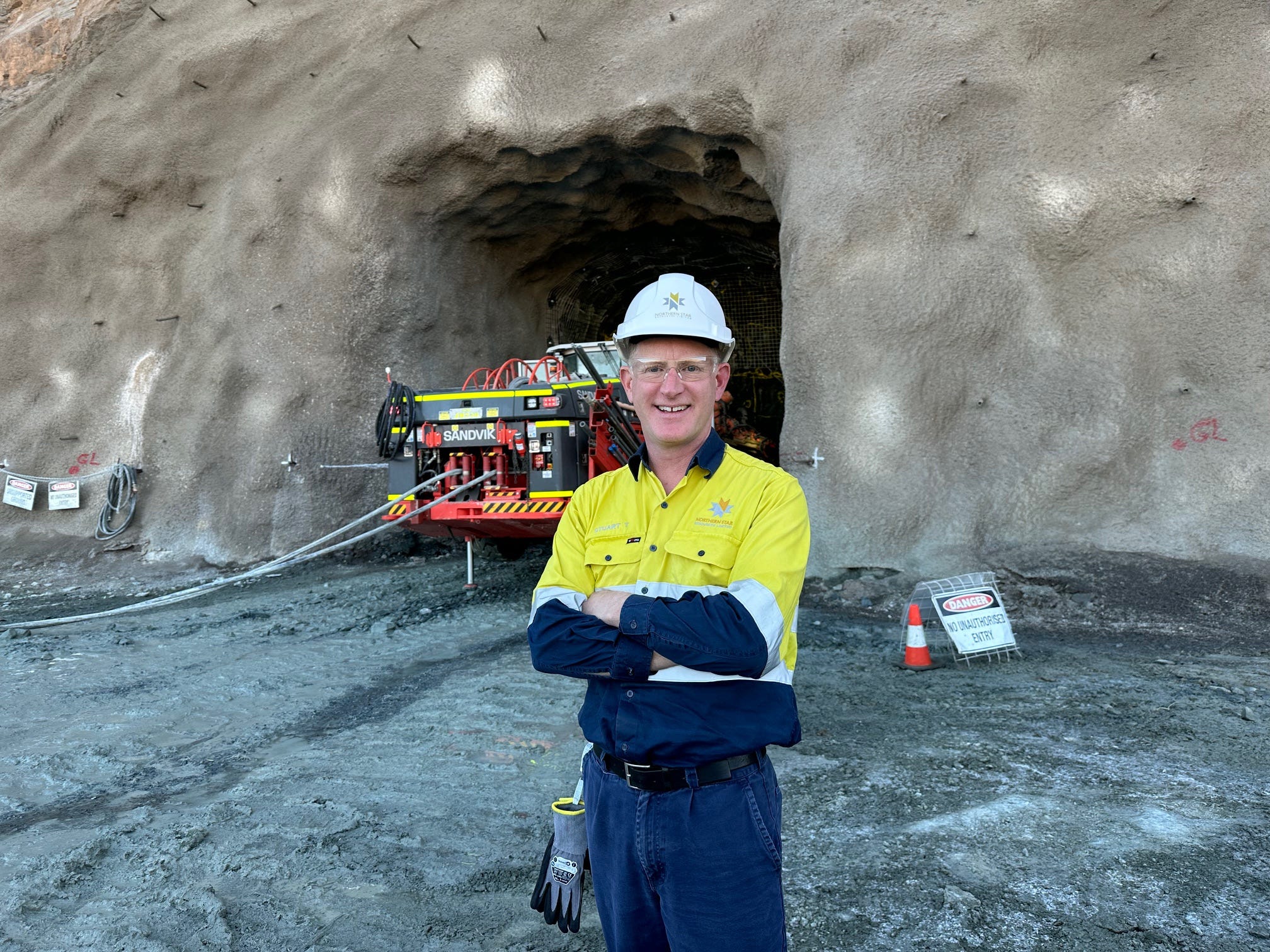
During a conference call on Monday, Northern Star managing director Stuart Tonkin confirmed the company was on track to produce 871,000-971,000oz in the current half.
FY26 AISC guidance is A$2300-2700/oz and the impact of the guidance downgrade on costs will be announced on January 22 when the company releases its full December quarter report.
“I’d like to reinforce our confidence in the underlying asset portfolio and thank our teams who worked to address the recent operational impacts promptly and safely,” Tonkin said.
“Our long-term value creation strategy is sound, and we’re excited at the prospects of commissioning the new Fimiston plant [at KCGM] in six months’ time, which will deliver a step change in production and costs for the business.
“I appreciate investors’ understanding of the near-term volatility of a growing business, and we will continue to prudently manage risks and liberate opportunities for the company.”
Northern Star sold 1.634Moz of gold at AISC of A$2163/oz in the 12 months to June 30, 2025.
Multiple setbacks
The company had previously flagged a circa 20,000oz impact to production due to operational disruptions at the Jundee and South Kalgoorlie mines in Western Australia.
At KCGM, gold production of 110,000oz was impacted by reduced throughput in the processing plant over four weeks because of the failure of the primary crusher.
Recommissioning started on Monday, though the company warned that throughput would vary in the current half as it transitions from the existing plant to the new expanded mill, which is on track for commissioning in early FY27.
At the Yandal Production Centre in WA, Jundee and Thunderbox both underperformed.
Recovery works on a structural failure in the Jundee crushing circuit took longer than expected, while Thunderbox sales were impacted by continued lower mined grades from the Orelia open pit and unplanned processing downtime associated with carbon-in-leach tank failures.
Pogo in Alaska was impacted by lower mined grades due to underground mining dilution.
Tonkin described the issues as “finite, discrete, one-off and rectified”.
Balance sheet strong
Northern Star reported cash and bullion of A$1.51 billion as of September 30.
“Notwithstanding the challenging operational quarter, the company remains in a great financial position entering the second half of financial year ’26,” Northern Star chief financial officer Ryan Gurner said.
“At 31 December, the company’s preliminary cash and bullion holdings are expected to be approximately A$1.17 billion, and with the company’s A$1.5 billion credit facilities, undrawn, total liquidity is approximately A$2.7 billion.”
Gurner confirmed the company would report negative free cashflow for the December quarter due to weaker production and a A$250 million tax balancing payment for FY25 which was made during the quarter.
Northern Star has been unwinding its hedging commitments and has 330,000oz at A$3181/oz due to be delivered in the current half.
Growth capital guidance for the current financial year is A$2.125-2.27 billion, with over half attributed to the final stages of the three-year, A$1.5 billion KCGM mill expansion.
Sell-off overdone?
Northern Star shares fell by as much as 10% on Friday and closed 8.6% lower, equating to A$3.3 billion drop in its market capitalisation.
“Assuming that these issues are merely one-offs, with production normalising over 2H, we would argue the response is potentially overdone,” Bell Potter analyst Regan Burrows said.
“On our estimates, we model a -12% impact to EBITDA (A$460 million) for FY26. Assuming an EV/EBITDA multiple of 7.8x prior to the announcement, the 8.6% stock price decline is in-line with our EBITDA adjustments however, making a case for the sell-off being warranted.
“Looking through the noise, with gold at US$4392/oz (A$6555/oz) this implies an AISC margin of A$4055/oz, or 62%, prior to adjusting for the hedge book (54% after accounting for hedged ounces).”
Burrows said Northern Star would continue to generate above-average returns in the current gold price environment.
He maintained a buy rating and A$30 price target. Northern Star shares closed 2.1% higher at A$24.95 on Monday.