

While gold and silver have reached record highs in 2025, platinum and palladium prices have also rallied.
Platinum was the best-performing commodity in the first half of the year, as much as doubling in 2025, while palladium has also surged.
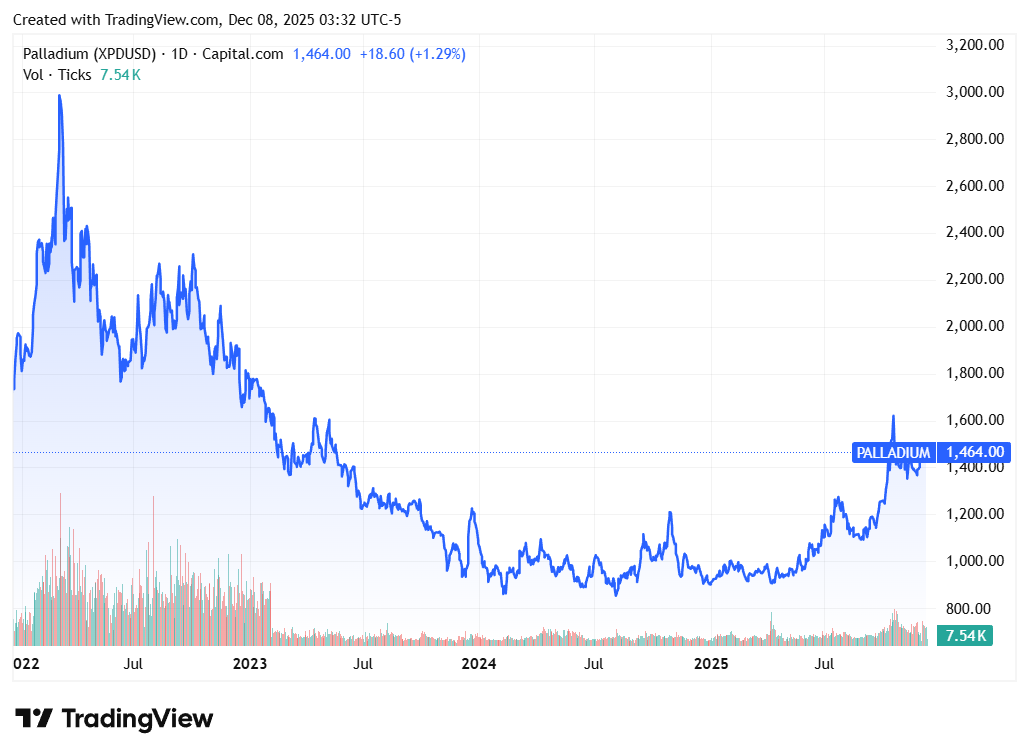
In the case of palladium, it reached an all-time high of US$3440 an ounce in early 2022 due to Russia’s invasion of Ukraine but has languished at below US$1000/oz for parts of 2024 and 2025.
The price fell to as low as US$880/oz in April.
“Currently we’re trading at closer to US$1500 an ounce,” Chalice Mining (ASX: CHN) managing director Alex Dorsch said.
“So clearly that’s telling us that the market is short again, and hence prices are rising.
“You can just look back to the 2019-2020 period to see how rapidly the market can move into deficit, and prices can really accelerate very rapidly, and that is the nature of this being a very, very small market.
“Importantly, there is just no elasticity in palladium supply, so even if we do see high prices, like what we saw between 2020 and ‘23, there was no additional supply added to the market.”
Roughly 90% of palladium production comes from Russia and South Africa, and, according to Chalice, South African producers have underinvested by around US$18 billion in the past decade.
While small at around 9 million ounces, the global palladium market has been in deficit for 10 of the past 11 years.
Recycling has underperformed and demand has been stronger than expected due to the popularity of hybrid vehicles.
‘Generational’ asset
While Ivanhoe Mines’ (TSX: IVN) Platreef mine in South Africa recently started production, there are very few PGM development projects globally.
One of those is Chalice’s Gonneville project, just 70km northeast of Perth in Western Australia.
On Monday, Chalice released a prefeasibility study for the project, which was discovered in March 2020.
Capital costs for the initial stage of the 23-year open pit operation were forecast at A$820 million.
The project is expected to produce 220,000 ounces per annum of 3E (palladium, platinum and gold), 7000 tonnes per annum of nickel, 8000tpa of copper and 700tpa of cobalt at all-in sustaining costs of US$50/oz of 3E, net of by-product credits, in the first three years and averaging US$370/oz over the mine life.
The second quartile costs are expected to be the lowest for a PGM project outside of Russia.
Using metal price assumptions of US$1300/oz of palladium, US$18,750/t of nickel and US$10,500/t of copper, the project is expected to generate cumulative pre-tax free cashflow of A$4.7 billion, increasing to A$6.2 billion at spot prices.
The project has a post-tax net present value (8% discount rate) of A$1 billion, increasing to A$1.5 billion at spot prices, a pre-tax internal rate of return of 23%, increasing to 29% at spot.
Argonaut head of research Hayden Bairstow said the PFS confirmed Gonneville as a “generational” asset.
The first stage of the development is expected to be paid back in 2.7 years, or 2.4 years at spot.
An A$840 million expansion from 5 million tonnes per annum to 14Mtpa in year five is expected to be funded out of post-financed cashflows.
The study was based on a maiden ore reserve of 260Mt at 0.86 grams per tonne 3E, 0.16% nickel, 0.098% copper and 0.017% cobalt for 7.1Moz of 3E, 400,000t of nickel, 250,000t of copper and 43,000t of cobalt, representing roughly 50% of the project’s resource.
“What we’ve released today confirms what we’ve known for a while, which is that we have a standout development project and a standout opportunity in the critical minerals space, and very much a unique asset in Western Australia,” Dorsch said.
Palladium is expected to generate around 51% of Gonneville’s revenue, followed by nickel (22%), copper (17%) and platinum-gold-cobalt by-products (10%).
“Really what makes the project unique is the leverage it has to palladium,” Dorsch said.
“There’s just so few development projects globally in palladium, and we’re looking at about a A$250 million increase in the NPV per US$100 per ounce increase in the palladium price, so there’s a fantastic leverage to the upside, and what we think is a rapidly increasing price environment.”
‘Quite novel’
Chalice has invested more than A$240 million in Gonneville in the past five years to de-risk the project, including the A$50 million acquisition of private farmland on which the deposit sits.
“We’ve got strategic and major project status from state and Commonwealth governments, so we have every bit of government support that is possible at this point of a project, so we’re very, very confident in the development path and the approvals pathway ahead,” Dorsch said.
“We’re going to really do something that’s quite novel in Australia. We’re going to build Australia’s first palladium mine.
“There are just very, very few assets like this around in critical minerals, and certainly in palladium, and we expect to attract significant amount of debt funding to help us execute on those plans.
“There is a significant pool of debt funding out there for critical minerals projects, particularly ones of scale, and I think what differentiates this and puts it in such a different category to most other projects is that mine life and the margins over that mine life.”
Dorsch said the company had already had good engagement with export credit agencies.
“It goes without saying, they’ve already become very excited and very attracted to our project given the scale and metals mix,” he said.
Chalice will move into a full 18-month feasibility study, which is fully funded, due to the company’s A$76 million in cash and listed investments.
The company has a non-binding memorandum of understanding with Mitsubishi Corporation, which has provided technical and marketing guidance.
“We have a lot of strategic interest in the asset, so we are looking to engage with those strategics now very actively following the release of this PFS,” Dorsch said.
Chalice is targeting a final investment decision in the first half of 2028 and first production in 2030.