
Perpetua Looking at Stibnite’s Tungsten Potential
Idaho mine will already be a major antimony producer in addition to the US’ largest independent gold mine

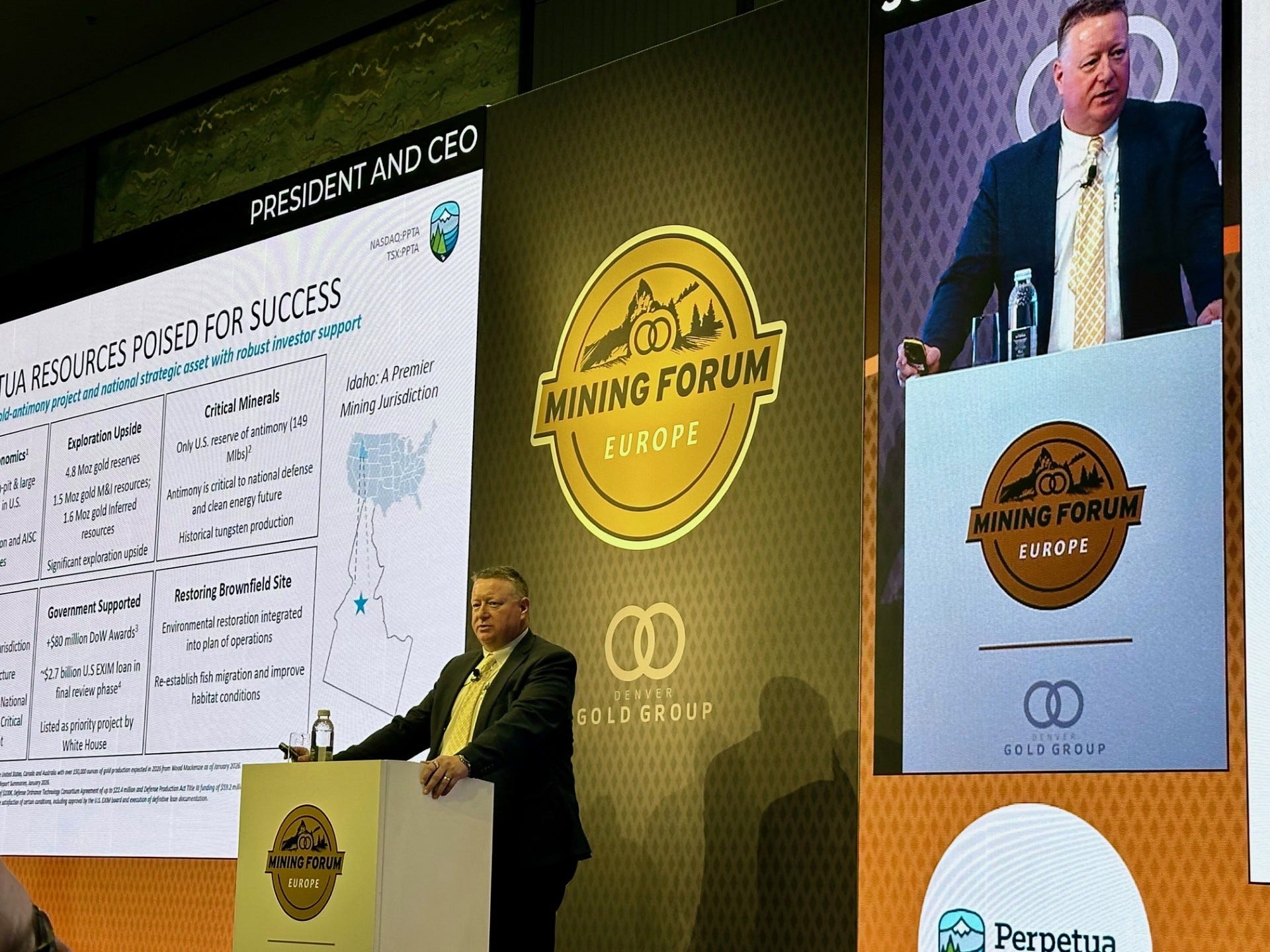
Perpetua Resources (TSX: PPTA) CEO Jon Cherry revealed at the 2026 Mining Forum Europe in Zurich that the company was looking into the tungsten potential at its Stibnite gold-antimony project in Idaho.
Tungsten has been the biggest metal mover so far in 2026, surging to record highs of more than US$3000 per metric tonne unit.
China is the world’s largest tungsten producer but, like many other critical minerals, it has imposed export restrictions.
Just 13% of global tungsten supply comes from the West.
Tungsten is on the critical minerals lists of the US, EU, Japan, Korea and Australia and its criticality has only increased given its use in military applications.
Lowell Resources Fund chief investment officer John Forwood, who will deliver a keynote at Mining Forum Europe on Wednesday, said earlier this month that he expected the tungsten price to remain elevated for the next 3-5 years.
“It’s very hard to see where additional Western supply is going to come from in the near to mid-term,” he said.
Stibnite is a brownfields site and was previously a major producer of tungsten.
Cherry said the historical mine supplied about 90% of the antimony and 50% of the tungsten required in 1942 for the Allies during World War II.
According to testimony in the 1956 Congressional Record, the Munitions Board believed the discovery of tungsten shortened WWII by at least one year.
While tungsten reserves at Stibnite have been depleted, exploration potential remains.
“Antimony has been a high-profile critical mineral in the last couple of years, but tungsten is now more critical than antimony,” Cherry said.
“We’ve been asked to go back and dust off the tungsten files and look and see what’s out there on tungsten.”
Tungsten could provide another leg to what is already a major US project.
Stibnite hosts 4.8 million ounces of gold in reserves, as well as 3.1Moz of resources.
It also has reserves of 149 million pounds of antimony, representing the only US reserve.
“It’s also one of the largest reserves in the world,” Cherry said.
Perpetua, which is backed by Agnico Eagle Mines (TSX: AEM), expects to finalise an antimony offtake deal this year.
For the first time in 10 years, Perpetua has exploration drill rigs turning at Stibnite.
“We have significant upside exploration potential that we’re pretty excited to talk about,” Cherry said.
“Obviously, critical minerals are a key part of this.”
Stibnite advancing
The Stibnite project is fully permitted and construction got underway in October 2025.
On March 31, Perpetua announced that the board of the Export-Import Bank of the United States unanimously agreed to notify Congress of a proposed US$2.7 billion senior secured long-term loan for Stibnite.
This decision triggered a 25-day notice period to Congress and is the last formal step before the bank’s board will vote on final approval.
“Last year, we raised about US$850 million of equity for the project, and at the end of the year, we had US$714 million in the bank,” Cherry said.
“That’s the money we’re using to do early construction work right now, placing orders for long lead equipment, and moving the project forward as quickly as we can.
“As you can imagine, with the investment from the government and their need for critical minerals, we’re trying to go as quickly as we can to get that going.”
Stibnite has capital costs of US$2.576 billion.
Using long-term consensus pricing of US$3250 per ounce of gold, US$10 per pound of antimony and US$40/oz of silver, the project has a US$3.5 billion unlevered, after-tax NPV (5% discount rate) and 23.5% internal rate of return.
Assuming a US$4500/oz gold price, the NPV rises to US$6.1 billion and IRR increases to 32.3%.
“Obviously, everyone likes to talk about the antimony and the critical nature of the antimony, but the economics are overwhelmingly driven by the gold,” Cherry said.
Stibnite is expected to start production in 2029, producing 463,000 ounces of gold per year over the first four years at all-in sustaining costs of US$498/oz, net of by-product credits.
Perpetua expects Stibnite to be the world’s lowest cost gold mine producing more than 150,000 ounces of gold per year in a tier one jurisdiction, thanks to a US$220/oz by-product credit from antimony.
At US$25/lb of antimony, the by-product credit would increase to US$547/oz.
“Last year, when antimony got up to about US$25 a pound, we would have actually been a negative cash cost producer for 460,000 ounces per year, so depending on the price of antimony, it’s a very, very nice benefit,” Cherry said.
The project is expected to produce a total of 4.2Moz of gold and 107Mlb of antimony over 15 years.