
Agnico Still Sees a Future in Finland, Australia, Mexico
Canada accounts for 85% of production but other region are still core

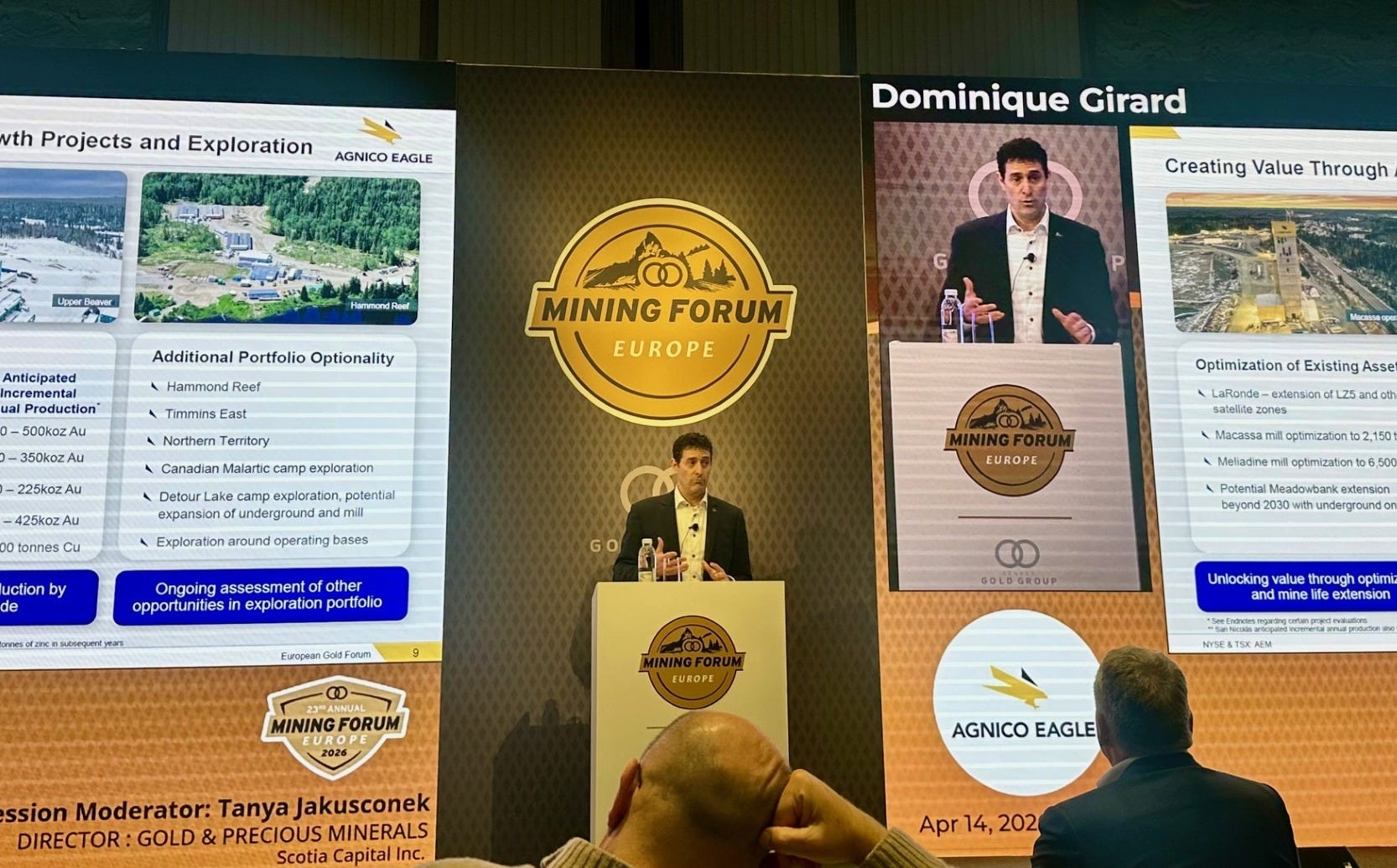
While it may be a seller’s market for gold assets, Agnico Eagle Mines (TSX: AEM) has no plans to divest its operations outside Canada.
Agnico’s Canadian portfolio, which includes the country’s two largest gold mines Detour and Canadian Malartic, accounts for 85% of its annual production of 3.3-3.5 million ounces of gold.
The company’s main growth projects, including expansions at its two largest mines and the developments of the Upper Beaver and Hope Bay projects, are all in Canada.
Speaking at the Mining Forum Europe in Zürich on Tuesday, Agnico chief operating officer, Nunavut, Quebec & Europe Dominique Girard said the company often got asked if its Kittilä mine in Finland and Fosterville mine in Australia were still core assets.
Kittilä’s guidance for 2026 is 220,000 ounces of gold, while Fosterville is set to produce 150,000oz.
“We don’t see them as non-core assets, because both of the sites have a long life of mine,” Girard said.
“In fact, in Australia, that’s the longest life of mine that site has ever had.”
Girard added that both sites had exploration upside and were generating around US$1 million of free cashflow per day at current gold prices.
“They are providing value to us, and both places, Kittilä and especially in Australia, it is really difficult to start a new mine and to build a new mine,” he said.
“So, having those assets, it’s an added value, and we keep the regional thinking, ‘okay, how could we build on that at the same place or around-ish, that we could use the synergy we have with the team, the synergy we have with the infrastructure?’” he said.
“So, there’s no plan to let those go for now.”
Pinos Altos in Mexico is the smallest asset in Agnico’s portfolio and is guided to produce 75,000oz of gold this year, though the company also owns 50% of the San Nicolás base metals project in partnership with Teck Resources (TSX: TECK).
“There’s two, three years [of mine life] in front of us” Girard said.
“The team is looking, with the current gold price, could we extend it? Because again, we have the thing built, and we have the team. We’ll see if there’s something.
“But the thinking is to use the workforce and the knowledge to help and to develop San Nicolás, so we’re still into the permitting phase, into the study phase.”
Early options
Earlier this year, Agnico revealed it was open to M&A.
Girard said the company was invested in around 60-70 early-stage projects.
“Some of them are public, some of them are not,” he said.
“And really, that’s the way we’ve been building the company.”
Recent deals include an investment in Cascadia Minerals (TSXV: CAM) and an increase in its stake in Maple Gold Mines (TSXV: MGM), but it also has stakes in companies including Perpetua Resources Corp (TSX: PPTA), Osisko Metals (TSX: OM), Fuerte Metals Corporation (TSXV: FMT), Rupert Resources (TSX: RUP) and Collective Mining (TSX: CNL).
“Our goal by doing that is to have access to the data, having access to the people, being more comfortable with the region, to get the knowledge, that advantage,” Girard said.
“Often the value of the project is well-priced, so you need to see through that. You need to see through the exploration potential, to match the value and to create the value.
“We’re patient so often it could be two years, five years, seven years, working with the junior company to help them to develop the project.
“It’s good for us, but it’s also good for them because we could provide some technical knowledge and help on how to develop the project.”
Girard said it boiled down to two criteria: could the company build many mines in the region? And was the jurisdiction stable?
“So, even though we could build many mines in Africa, we won’t go there,” he said.