
Investors Are Still Underweight Gold
What will it take to get allocations up?

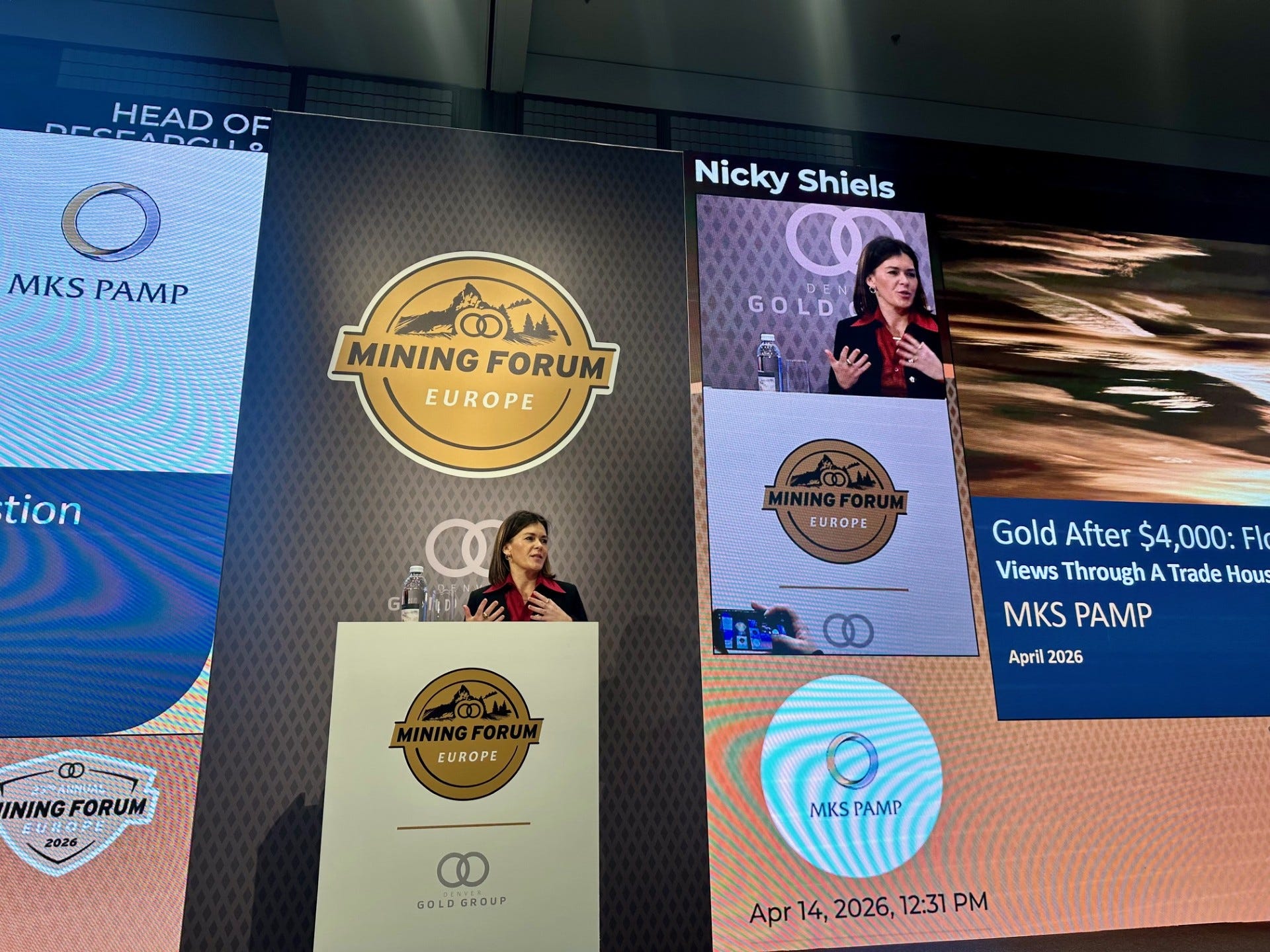
Despite the heightened interest in gold in the past year and new highs in the price, US institutional investors are still largely underweight gold, according to MKS PAMP head of research & metals strategy Nicky Shiels.
While Shiels told the Mining Forum Europe in Zürich on Tuesday that she was surprised by the huge retail interest in gold recently, gold was still estimated to represent just 2% of family office portfolios.
According to Bank of America, since the pandemic, US$5 trillion had gone into cash, US$3 trillion had gone into equities, versus just US$200 billion into gold.
“In a nutshell, investors are not overweight. Investors are sort of neutral to underweight,” Shiels said.
“The follow-up question is, ‘okay then, who’s missing? What needs to come together in order for us to get to 5% of allocations to gold?’ and it generally is US institutional investors.”
Shiels asked AI chatbots Grok and Claude why US institutional investors were not more into gold.
“Grok told me, ‘US institutional investors view precious metals as a dead money boomer rock and doomer insurance’, whereas Claude was actually more constructive,” she said.
Claude said US institutional investors had long been dismissive of precious metals but “had been forced to capitulate, given that gold and silver were now boardroom legitimate, with the biggest desks on Wall Street piling in and slapping US$6000 price targets on gold”.
So, what would it take for US institutions to increase their gold holdings?
“A crisis needs to happen, I think, unfortunately, in order to jump start those institutional flows into gold,” Shiels said.
Morgan Stanley has recently been touting a 60:20:20 portfolio as an alternative to the classic 60:40 portfolio where 60% is allocated to equities and 40% to bonds.
Under the Morgan Stanley model, 60% would be allocated to equities, 20% to fixed income and 20% to gold.
Shiels said that was unrealistic due to the size of the gold market.
“It’s too small – looking at the size of fixed income bonds and equities, it’s a fraction,” she said.
“From an ounces perspective, I don’t think the market’s large enough to take that.
“I think we can talk high single digits, 5-10%, and see how the market reacts with that.”
Higher for longer
Shiels remains bullish on gold but said its upwards trajectory would weaken.
She expects another circa 30% rise in the gold price this year.
The key risks for gold were a lack of institutional interest, a rise in supply and central banks becoming net sellers.
“Right now, they’re still, on aggregate, net buying, but at a slower pace versus last year,” she said.
Overall, Shiels sees gold as being in a consolidation phase, echoing fellow keynote speaker Jefferies global head of equity strategy Chris Wood.
“We’re looking at US$4200 to US$5000,” she said.
“The high for this year is US$5800, but again, we’re now in a healthy environment where it’s not one-way pricing, it’s more two-way.”
While gold had its best year ever in 2025 with a 65% increase, the next three best performance years were 2007, 2010 and 2024 when it rose around 30%.
“For me, putting US$5800 as a target for this year, a 34% gain, is very fair,” Shiels said.
“2027, 2028, I think you’re looking at 10-20% gains again.
“The trajectory is going to get increasingly more mild, but I still think higher for longer throughout this decade.”
Physical availability risk and liquidity risk for gold remained low, as opposed to medium-to-high for silver, platinum and palladium.
Shiels’ 2026 forecast for silver is an average price of US$75/oz with a high of US$120/oz.
For platinum and palladium, the forecast estimate is US$2000/oz and US$1700/oz, respectively, with highs of US$3000/oz and US$2300/oz, respectively.
“Still bullish, but we’re going through a stagflationary environment,” Shiels said.
“I think the industrial complex – whether it’s copper, silver or PGMs – are probably not going to outperform gold.
“They’ll be dragged up, but stagflation is just the Goldilocks backdrop for gold.”