
Major Gold Miners Should Be Investing More in Juniors: Adshead
The case for big companies running their own internal funds

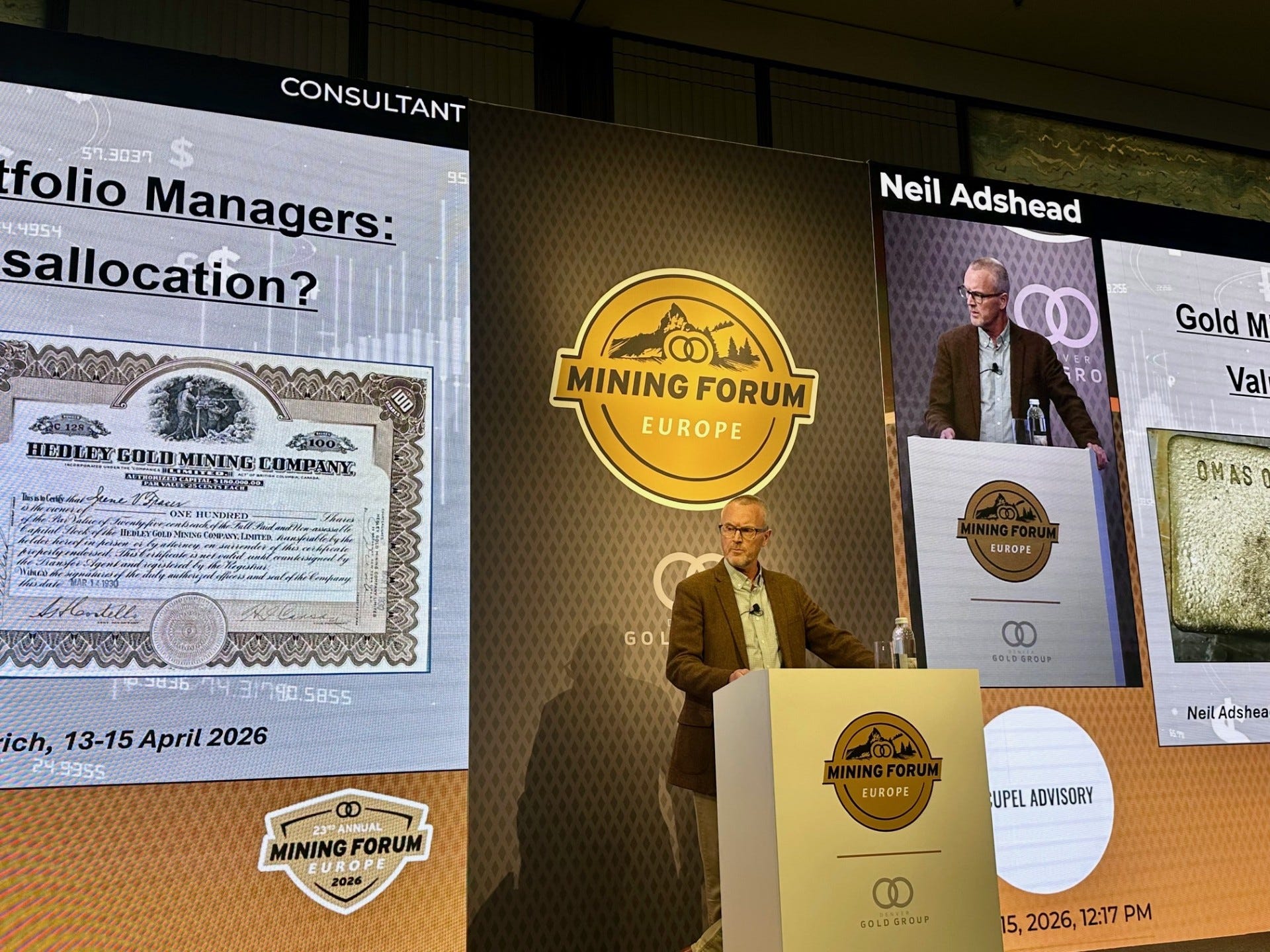
Cupel Advisory Corp’s Neil Adshead has made the case for why the major mining companies should be using some of their excess cash to invest in junior miners.
Speaking at the Mining Forum Europe in Zürich this week, Adshead, an economic geologist and former fund manager, said gold companies were making “absolutely crazy” amounts of money.
“We’ve seen the mining companies generate so much money they’re almost a little bit unsure what to do with some of it, and I think building a proper equity portfolio would be a smart move,” he said.
Adshead cited figures by Canaccord Genuity, which suggested the North American gold sector would generate US$35 billion of free cashflow this year and would have a total of US$42 billion of cash on their balance sheets by the end of the year.
“What are they going to do with that cash? We’ve seen dividends increase and share re-purchases,” Adshead said.
“Who really buys mining companies’ shares for the dividend? I don’t think many of us do. I think most of us would prefer to see the mining company increase their exposure to the metal units, because, I would argue, most of us invest in mining companies because we believe in the commodity.”
One of the ways mining companies can spend their cash is via exploration, but there’s yet to be significant increases across the large producers.
“I used to work for a major mining company many years ago and I would argue that we spent a lot of money, but it wasn’t particularly spent that wisely in terms of unit dollars spent for what they actually achieved,” Adshead said.
“I think the juniors generally do better exploration than the majors per dollar spent.”
Of 17 “newsworthy” gold discoveries made in the past decade, 12 were made by juniors.
Many of those juniors, including Great Bear Resources, GT Gold, De Grey Mining, Reunion Gold and Spartan Resources, have since been acquired.
“If I was an investor in a major and interested in their exploration function, I might be more interested in them taking that capital and investing in juniors and letting the juniors do the work, rather than the major doing it themselves,” Adshead said.
He said a company like BHP had a huge exploration budget but probably didn’t drill many holes.
“They’ll do lots of fancy office-based number-crunching type things, but they won’t get that many geos on the ground drilling holes, and that’s what you need to do to make discoveries.”
The new poster child
Adshead said Billiton was active in the 1990s in investing in juniors until it was acquired by BHP, then BHP had its Acorn project in the early 2000s.
It had more recently launched BHP Xplor to mentor junior explorers.
Adshead described Agnico Eagle Mines (TSX: AEM) as a poster child for investing in juniors.
Agnico chief operating officer, Nunavut, Quebec & Europe Dominique Girard told the same event the company was invested in 60-70 juniors.
Adshead has been hired by Centerra Gold (TSX: CG) on a part-time basis to take US$25 million and build a portfolio of early-stage gold explorers focusing on eastern Canada and the Great Basin of Nevada.
“The objective here was to gain exposure to high quality in greenfields gold exploration risk … so I look for risk. I want high-quality risk. I’m looking for the best exploration teams,” he said.
“The key is not about the share price performance. Everybody’s happy – the portfolio’s up over 100% which is roughly close to a US$20 million gain on the balance sheet.
“That’s not really the aim of it. The aim of it is that the exploration team has then got access to the kind of early access – not priority over shareholders – but because you’re close to the story, because you own the stock, and you’ve been to site, and you know the people, they tend to call you up.”
Centerra has optioned four projects from the juniors, three of which will be drilled this year.
“If one of these turns into a new gold discovery in Ontario, for example, then it’s going to be an incredibly successful strategy,” Adshead said.
The strategy had given Centerra a reputation as a partner of choice.
Deals are coming to Centerra now from left field … so it’s a great business advantage for the company, too,” Adshead said.
Miners as asset managers
“The more I think about this, if I ever went back into asset management, I’d love to do it inside a gold mining company, not in the public market, and I’ll explain why,” Adshead said.
Adshead said there was one capital source and little reporting and no marketing required.
“It’s a bit like a family office. You’ve got sticky money. You’ve got essentially zero redemption risk,” he said.
“One of my biggest sweaty moments as a fund manager was 25% of the fund could disappear every quarter, so I was restricted on what I could buy from a liquidity point of view, which is a little bit scary.”
Being inside a gold miner would also ensure access to a broad spectrum of technical expertise.
For the junior, it was all about access to supportive, and often recurring, capital.
“The junior having a major mining company as a partner is pretty good. That money is generally not going to disappear,” Adshead said.
“I like to almost take the pressure off the junior having to constantly look at the share price and raise money. I want you to have US$30 million, I want you to go to design a 60,000m drill program for the next 30 months.
“You don’t even have to worry about the market and share price. Focus on geology and saving the make a discovery.”
Adshead said a portfolio strategy was a good one for major and mid-tier miners, provided it was managed properly.
“I think I’d like to see a major hire an experienced portfolio manager plus a technical analyst, if the portfolio manager didn’t have the technical experience themselves,” he said.
“I think if they were properly incentivised, it’d be a great addition to the growth profile for every major mining company that’s generating a lot of cash right now – and they all are.”