
Whiplash for Gold Investors After Volatile Week
Upside risks remain for gold, despite volatility


Analysts believe upside risks remain for the gold price, despite deepening market uncertainty and volatility.
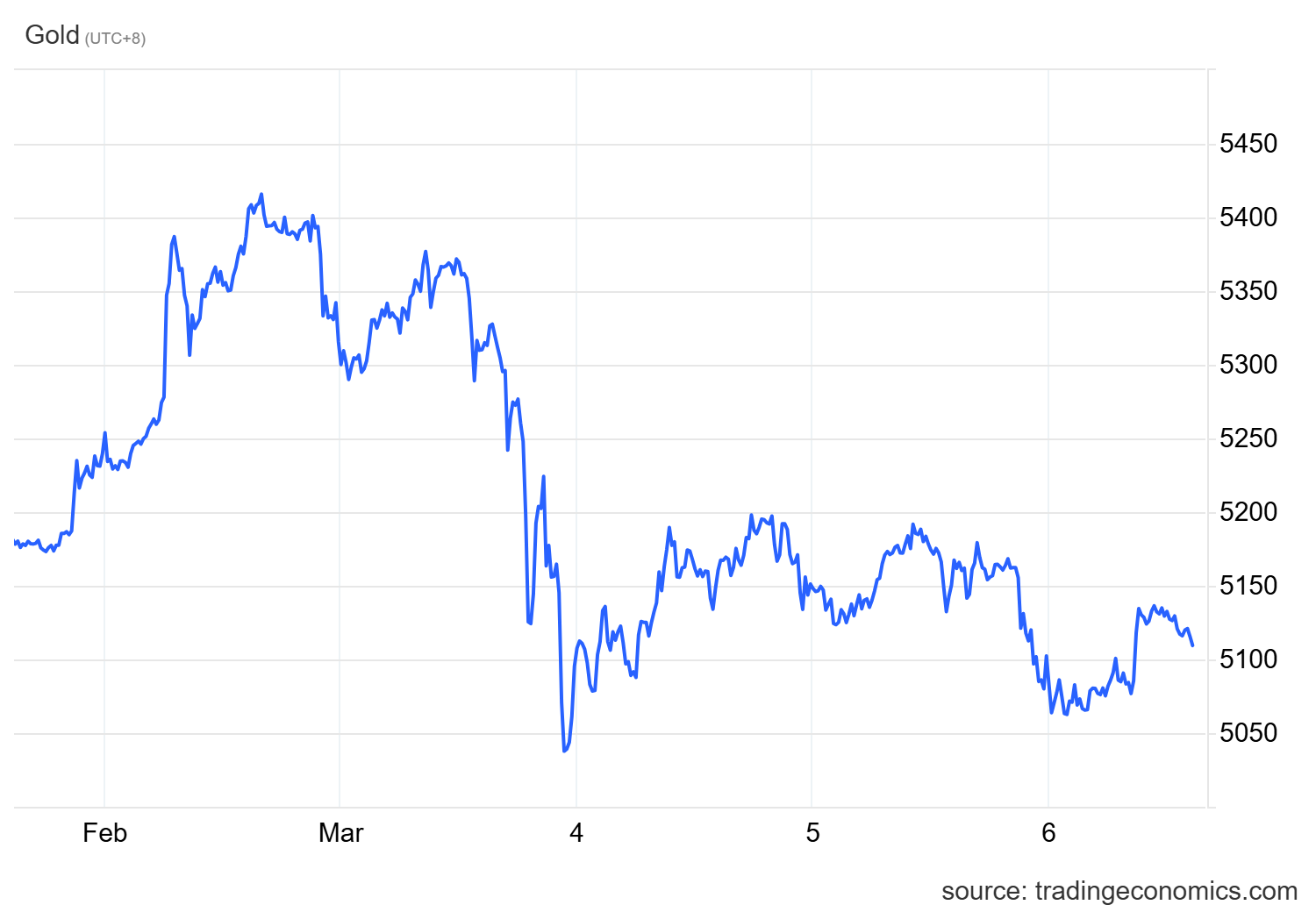
Spot gold jumped to more than US$5420 an ounce at the start of the week, as the US and Israel first launched attacks on Iran.
Iran’s attacks on multiple countries in the region rattled global markets, with the gold price plunging to just above US$5020/oz.
It has since partially recovered to trade in a range of US$5120-5200/oz.
“Importantly, with very little clarity on likely timelines and the very real risk that the conflict widens even further, there remains considerable upside risks for gold,” Metals Focus said.
According to the precious metals consultancy, gold’s geopolitical premium rarely lasts, but said this time could be different.
“Even in cases when conflicts have been prolonged, investor fatigue has soon set in and appetite for safe haven assets dissipated,” it said.
“This will likely be the case again with the Iranian war. However, we believe that there is a sizeable tail risk that, due to the specifics of the conflict, this time things could be different.
“Iran’s location, its ability to materially impact flows of oil through the Strait of Hormuz, already reflected in a much higher oil price, and its retaliatory strategy of indiscriminately attacking neighbouring countries add extra layers of unpredictability to the situation.”
At least 13 countries are involved in the conflict, a figure which is growing by the day.
Gains short-lived?
Metals Focus’ base case is that the conflict will last for weeks, rather than months, given its unpopularity with the US public so close to the mid-term elections.
“Our base case is also that the extent of the war will be contained, as ultimately, it is in none of the participants’ interests for the situation to get completely out of control,” it said.
“Under this scenario, we expect rallies to, but probably not beyond, the previous all-time high over the next few weeks, triggered by news flow and spikes in escalation concerns.
“As the market consensus oscillates between this and the sort of complacency we have seen develop this week towards the war, corrections are also on the cards, resulting in a period of heightened volatility.”
The World Gold Council said historically, gold had risen in about two-thirds of instances in which geopolitical tension had spiked significantly.
“But the next two weeks are less certain, with gold showing a broader range of returns (+8% to -3%) and a hit rate that falls to 57%,” it said this week.
“Bottom line: the dollar bounce, boosted by the current conflict, is likely short-lived, and a resumption in the downtrend should be supportive for gold.”
Longer term impacts
A report by POLITCO this week suggested U.S. Central Command had asked the Pentagon to send more military intelligence officers to its Florida headquarters to support operations against Iran for at least 100 days, but likely through September.
Metals Focus said if one or more of the “fat-tail” risks materialised, it would expect gold to rally further and faster, likely reaching US$6000/oz by the end of the month.
However, even in that case, the impact of the war on the gold price would eventually wane, whether it be due to de-escalation or investor fatigue.
“Regardless of the outcome of the war, we have no doubt that it will contribute to the wider positive sentiment towards gold and its investment case,” Metals Focus said.
Metals Focus noted the limited flows into treasuries this week added to existing concerns about their traditional safe-haven asset role.
“This is clearly positive for gold, both directly, as it competes with treasuries for safe-haven investment flows, and indirectly, due to the impact these concerns are having on the US dollar,” it said.
Metals Focus argued the war would have lasting implications for US foreign policy due to its appetite to induce regime change through force, while its lack of coordination or consultation with most of its allies signalled a shift towards unilateralism.
“On balance, such shifts in the world’s largest economy and leading military power amplify geopolitical uncertainty,” it said.
There were also no guarantees the new Iranian regime would be more conciliatory, with reports suggesting the late Iranian supreme leader Ali Khamenei would most likely be succeeded by his son, Mojtaba Khamenei.
Argonaut boosts forecast
Australian firm Argonaut has again lifted its gold price forecasts for the next two years by 12-14%.
“The rising geopolitical tensions in the Middle East have added further weight to the bull case for gold,” analysts Hayden Bairstow and Patrick Streater said.
US government debt stood at US$38.4 trillion in December, up US$2.23 trillion for the year.
Argonaut said it had increased by a further US$400 billion this year, translating to an annualised rate of US$2.5 trillion and implying that US debt could surpass US$40 trillion by mid-year.
Gold ETF holdings had risen to just over 100 million ounces, up 21% since the start of 2025.
“The rising gold price has boosted the value of ETF holdings to over US$520 billion, climbing circa 140% in value over the same period,” Argonaut said.
According to the WGC, global investors continued to allocate to gold ETFs in February, marking the ninth consecutive month of net inflows, led by North America and Asia.
“The only other times when gold has recorded nine straight months of ETF inflows was during the GFC and COVID-19 pandemic – both periods of elevated systemic risks that prompted diversification into safe haven assets,” it said.
Argonaut has upgraded its March quarter 2026 gold price forecast by 15% to US$5050/oz and sees it reaching US$5600/oz by the December quarter.
The firm now expects gold to peak at US$6000/oz in mid-2027, up from its previous forecast of a peak of US$5200/oz.
Strength in the Australian dollar has offset rises for local producers. Argonaut continues to forecast a peak of A$8000/oz in the June 2027 quarter, up from the current price of around A$7260/oz.