
Agnico Eagle Boasts Gold Sector’s Best Growth Profile
Al-Joundi said the company was making sufficient cash to grow production and ramp up returns

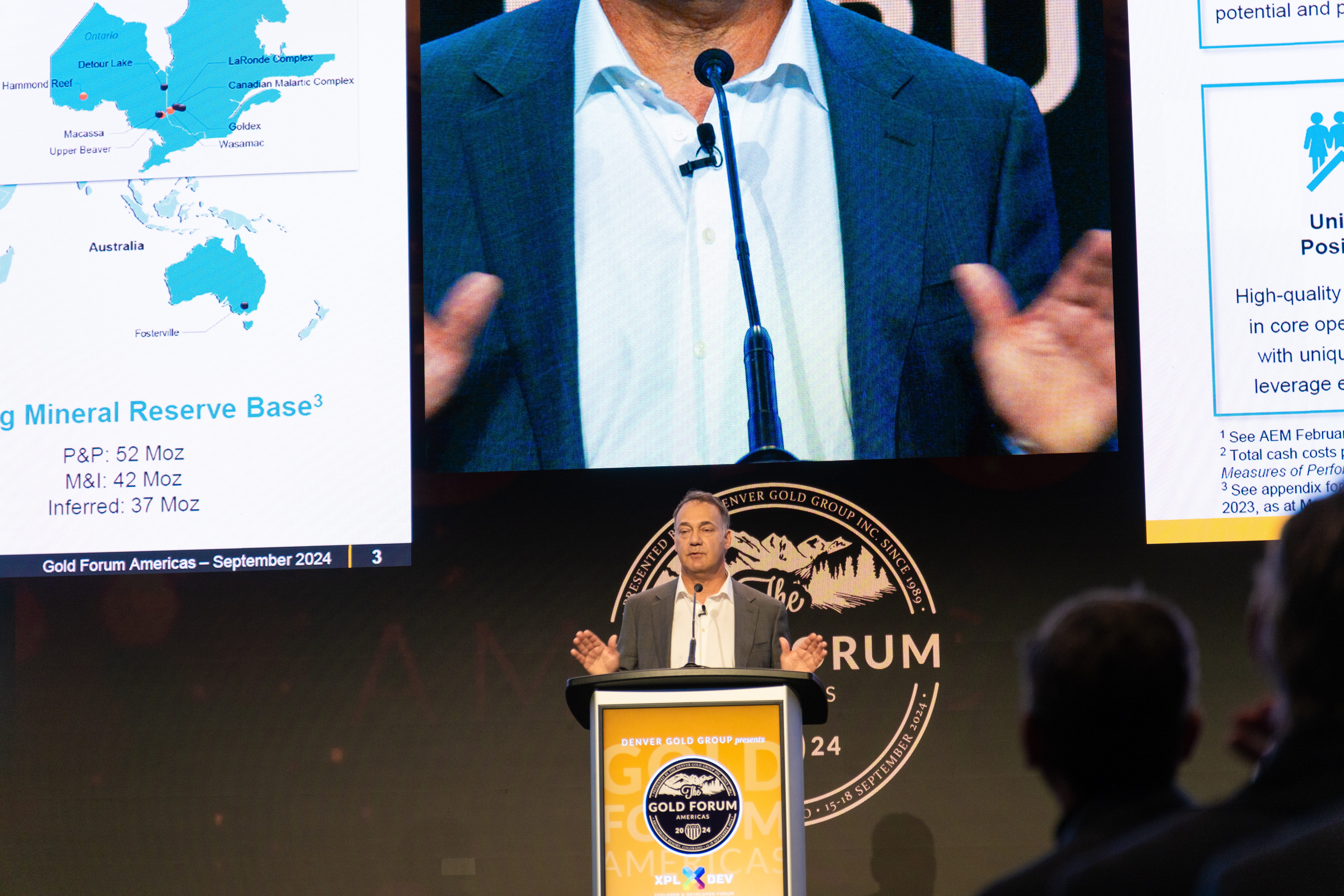
Agnico Eagle Mines (TSX/NYSE: AEM) has reported record operating margins and adjusted net income for the first quarter.
Agnico Eagle reported quarterly net income of US$1.7 billion, or US$3.39 per share, and record adjusted net income of US$1.70 billion, or US$3.41 per share.
The company generated cash provided by operating activities of US$1.34 billion, or $2.69 per share, and free cashflow of US$732 million, or US$1.46 per share, which included the impact of a US$1.3 billion payment for the remaining cash tax liability related to the 2025 taxation year.
Agnico reported first quarter payable gold production of 825,109 ounces, slightly above plan, at cash costs of US$1158 an ounce and all-in sustaining costs of US$1483/oz.
“We’re off to a good start to the year with solid operating performance, delivering record operational and financial results, record mill throughput at Macassa, record development rate at Meliadine, record pit tonnage at Detour,” Agnico Eagle CEO Ammar Al-Joundi said on a conference call.
“We’re delivering these solid operating results while doing an excellent job controlling costs, leveraging off our relentless focus on cost control while benefiting from certain structural cost advantages that derive from our business model.”
Agnico maintained 2026 guidance at 3.3-3.5 million ounces of gold, 52% weighted to the second half.
Guidance for cash costs and AISC remained unchanged at US$1020-1120/oz and US$1400-1550/oz, respectively.
“This is no small task, given the uncertainties and pressures in the market over the past several weeks,” Al-Joundi said.
The company said its focus on local procurement and resilient supply chains should insulate it from disruption to fuel and consumables supply.
Its cost guidance is based on an assumed diesel benchmark price of US78c per litre (excluding transportation and taxes), though 54% of its 2026 diesel exposure is hedged at US71c/L.
Diesel represents around 10% of Agnico’s operating costs and the company estimates a 10% change in diesel prices would impact total cash costs by roughly US$4/oz on a net basis after hedges, or around US$8/oz excluding the impact of diesel hedges.
Agnico Eagle’s cash balance increased by US$246 million to US$3.1 billion, resulting in a March 31 net cash position of US$2.9 billion.
“We distributed US$375 million to shareholders. We invested almost US$400 million into our high-quality growth projects, all while increasing our cash position by almost US$250 million,” Al-Joundi said.
“At these gold prices, we will increase our share repurchases, and we are increasing our normal course issuer bid to US$2 billion.”
Two weeks ago, Agnico Eagle announced the acquisitions of Rupert Resources (TSX: RUP) and Aurion Resources (TSXV: AU) and the acquisition of B2Gold’s (TSX: BTO) 70% interest in Fingold Ventures to consolidate its landholding in Finland.
The company plans to evaluate opportunities to reduce dilution associated with the Rupert transaction, including potentially returning the proceeds of portfolio investment sales to shareholders through share repurchases.
Unrivalled growth
“Perhaps the most important takeaway – we continue to aggressively reinvest in our business, into the best pipeline in the industry, into projects that deliver exceptional returns at relatively lower risk,” Al-Joundi said.
It’s part of a plan to increase gold output by 20-30% over the next decade, which includes increasing production at Detour and Canadian Malartic, already Canada’s largest gold mines, to 1Moz each per year.
Agnico Eagle will also make a final investment decision on the Hope Bay project in Nunavut this month, with the mine expected to contribute 400,000oz per annum by 2030.
“In addition, with the expected consolidation of our Finnish platform, we now see a path to further growth that comes from building a 500,000 ounce a year, multi-decade platform in what we believe to be the most prospective land package in Northern Europe,” Al-Joundi said.
“We will focus on the best mining jurisdictions based on geologic potential and political stability.
“We’ll be disciplined with our owners’ money, making investment decisions based on technical and regional knowledge, creating value through the drill bit and through smart acquisitions, where and when it makes sense.”
The company was again asked about its future in Australia and Mexico.
Al-Joundi said he visited the company’s Fosterville operation in Victoria, Australia about a month ago.
“We spent a lot of time on some recent, I would say, very good exploration results in and around Fosterville,” he said.
“That part of Australia was the original gold rush, and nobody’s really focused on it for decades, and it’s still very early, but I was quite pleasantly surprised with some of the results they were getting and the enthusiasm they had.
“We get questions all the time about the rest of Australia. We think Australia is a great place to mine, not just for gold, but you know us – we are very careful about what we do.
“We’re very disciplined, and right now we continue to be focused in Australia, at Fosterville, and the team we have there and the opportunities around that.”
On Mexico, Al-Joundi said he wouldn’t rule out consolidating the San Nicolás copper project if its 50% partner, Teck Resources (TSX: TECK), wanted to sell.
“We are looking at opportunities to expand San Nicolás but, beyond that, there’s really nothing substantial that we’re seeing as an opportunity in Mexico,” he said.